

Pilates Tree Exercise: A Complete Guide
13/01/2026The Pilates Tree exercise is an advanced movement that can be performed on various Pilates apparatuses, each offering a unique experience and level of challenge. Whether you are a beginner or already have a Pilates foundation, this comprehensive guide to the Tree exercise on the Reformer, Ladder Barrel, and Spine Corrector will help you practice correctly, effectively, and safely.
What Is the Pilates Tree Exercise?
Pilates Tree is an advanced exercise and one of the most recognizable movements in the Pilates system. It is easily identified by its climbing-like motion. The Pilates Tree emphasizes core control, spinal flexibility, and enhanced body awareness.
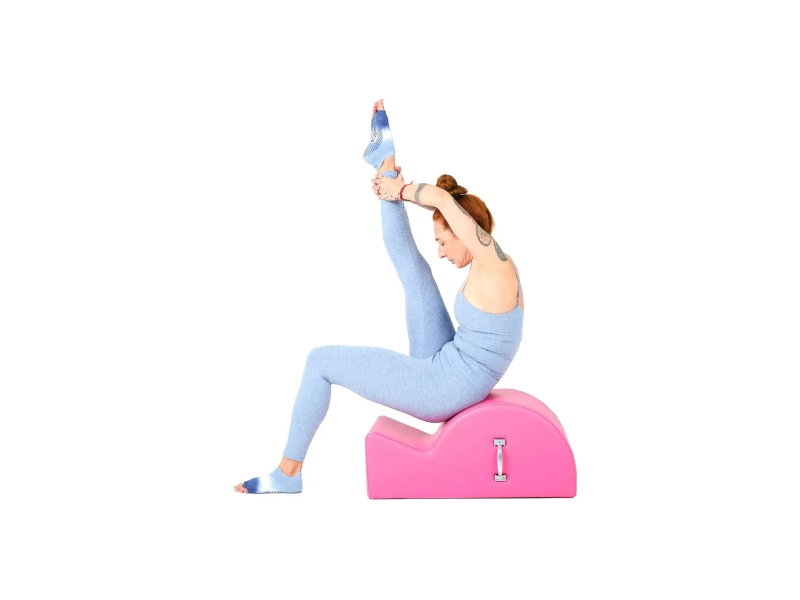
Pilates Tree exercise when performed on a Spine Corrector.
Depending on training goals and individual physical condition, the Tree exercise can be performed on the mat or on various Pilates apparatuses such as the Reformer, Ladder Barrel, and Spine Corrector.
Benefits of the Pilates Tree Exercise
The Pilates Tree is not only a technically demanding movement but also delivers exceptional benefits for spinal health and overall flexibility.
Improves spinal flexibility
Practicing the Pilates Tree on apparatuses helps lengthen the entire spine, from the lower back to the neck. This movement releases pressure on the vertebrae, enhances spinal mobility, and supports smoother, more fluid daily movement.
Enhances posture
Regular practice of the Pilates Tree helps lengthen and align the spine, leading to improved posture. Individuals who sit for long periods or struggle with poor posture often experience noticeable improvements, including reduced spinal curvature and a more upright stance.
Reduces tension and back pain
This exercise effectively relieves tension in the muscles surrounding the spine, particularly in the lower back. With support from the Reformer, Ladder Barrel, or Spine Corrector, pressure is
evenly distributed along the spine, helping reduce back pain, muscle tightness, and supporting recovery from chronic back discomfort.
Builds strength and body control
The Pilates Tree requires coordinated engagement of the abdominal, back, and hip muscles. This develops core strength while enhancing full-body control. Maintaining balance throughout the movement also improves muscular coordination and overall stability.
Pilates Tree Exercise on the Mat
The mat version of the Pilates Tree is very similar to the Roll Up, with the main difference being that one leg remains lifted throughout the movement.
The key advantage of the mat Tree is improved movement control through holding the leg, which creates leverage and makes rolling up from the mat easier. This is especially helpful for those who find a full Roll Up challenging.
How to perform the Pilates Tree on the mat
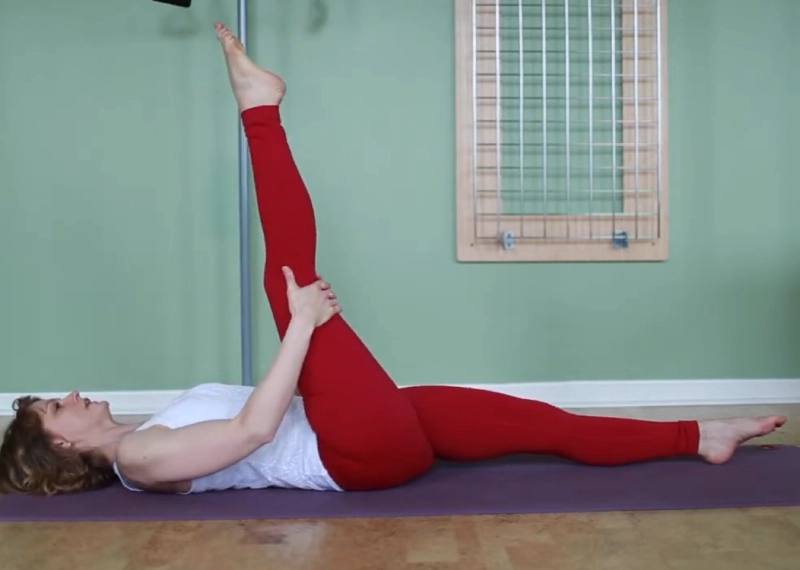
How to perform the Pilates Tree pose on a mat.
- Starting position: Lie on your back with both legs extended.
- Phase 1: Lift one leg to a vertical position while the other leg remains extended on the mat. Hold the lifted leg with your hands.
- Phase 2: Engage the abdominal muscles and roll up, bringing the forehead toward the knee. Keep the lifted leg straight and hold the position for several breaths.
- Phase 3: Slowly roll back down to the mat, returning to the starting position.
- Repeat: Perform the sequence with the opposite leg.
Pilates Tree Exercise on the Spine Corrector
The Pilates Tree on the Spine Corrector uses this uniquely curved apparatus to provide optimal spinal support and stretching.
In this variation, the movement begins from a seated position with one leg extended and the other bent. The body gradually rolls backward along the curve of the Spine Corrector, lengthening the spine while improving posture and enhancing flexibility in the hips and thighs.
How to perform the Pilates Tree on the Spine Corrector
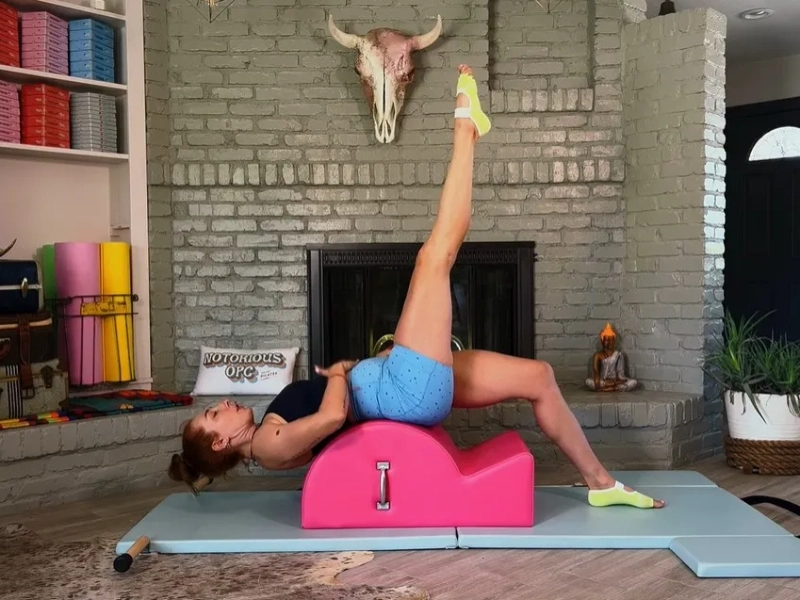
Perform the Pilates Tree on the Spine Corrector
- Sit on the Spine Corrector with your pelvis close to the edge of the apparatus.
- Extend one leg (commonly the left leg), while the other leg bends with the hand holding the ankle or lower leg.
- The free hand may rest lightly on the top of the Spine Corrector or extend forward for balance. Inhale deeply and lengthen the spine in an upright seated position, feeling the stretch along the spine.
- Exhale and slowly roll backward, articulating the spine along the natural curve of the Spine Corrector while maintaining the leg extension.
- Keep the head and neck relaxed, allowing natural spinal lengthening.
- When fully supported by the curve, extend the free arm overhead, either reaching toward the floor or keeping it overhead depending on flexibility.
- Hold for several breaths, feeling a deep stretch from the hips through the spine and chest. Exhale and roll back up slowly, articulating each vertebra until returning to an upright seated position, maintaining control and balance.
Pilates Tree Exercise on the Ladder Barrel
The Pilates Tree on the Ladder Barrel requires precise leg extension and spinal articulation while maintaining balance. With the support of the Ladder Barrel, this advanced exercise emphasizes breath control and body awareness throughout each movement.
How to perform the Pilates Tree on the Ladder Barrel
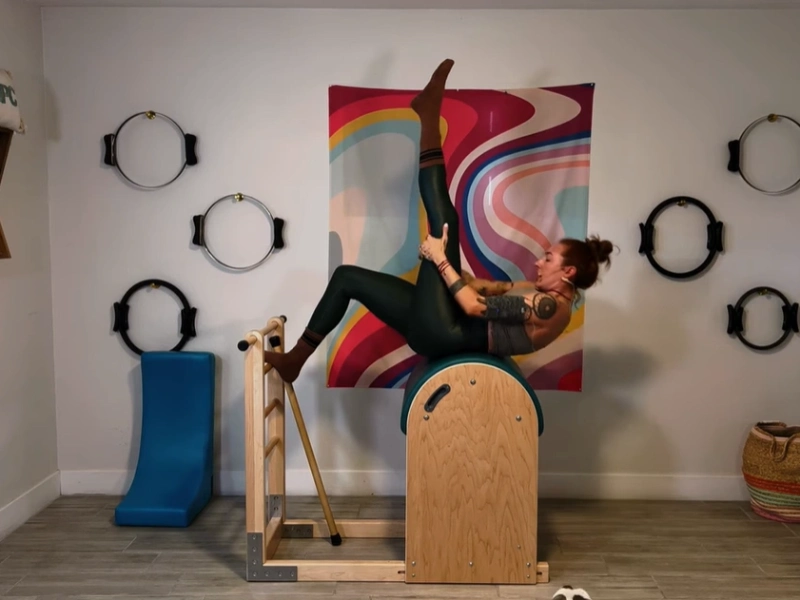
Steps to perform the Pilates Tree exercise on the Ladder Barrel.
Step 1: Setup
- Sit on the Ladder Barrel with the hips slightly forward on the rounded barrel, closer to the ladder.
- Place the arch of one foot on the second rung from the top.
Step 2: Knee bend and leg extension
- Gently draw one knee toward the chest, holding behind the thigh with both hands.
- Keep the thigh close to the chest and extend and bend the leg 1-3 times.
Step 3: Walk the hands to the ankle
- Walk the hands up the leg from the thigh to the ankle.
- As you do this, round the spine forward and draw the waist back to deepen the stretch.
Step 4: Roll back and walk the hands down
- Slowly articulate the spine back along the Ladder Barrel while walking the hands down the leg.
- Maintain controlled, fluid movement with continuous spinal lengthening.
Step 5: Repeat
- Roll up and down in this manner three times.
- If full extension over the barrel is not accessible, move only within a safe and comfortable range.
Step 6: Switch sides
After completing one side, switch legs and repeat the full sequence.
Pilates Tree Exercise on the Reformer
In the Pilates Tree on the Reformer, the body moves in a tree-like shape, with one leg secured in the strap while the other leg lifts and lengthens, promoting spinal extension and balance.
How to perform the Pilates Tree on the Reformer
Preparation
- Sit on the moving carriage.
- Secure one foot under the strap while the other leg bends toward the chest.
- Sit upright, holding behind the thigh of the lifted leg.
- Extend and bend the knee 1–3 times to stretch the hamstrings and sit taller.
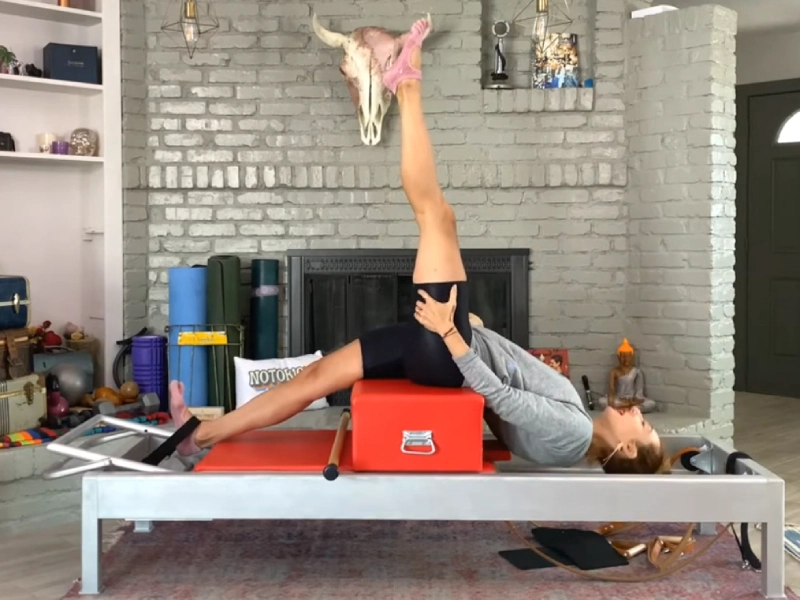
Perform the Pilates Tree on the Reformer.
Execution
- Inhale and lift the bent leg higher, walking the hands up toward the ankle.
- From the spine, reach forward, rounding the back and bringing the head toward the knee while keeping the pelvis stable.
- Walk the hands down the lifted leg as the spine extends backward, moving into spinal extension if flexibility allows.
- Engage the abdominals and back muscles to walk back up to the ankle, rounding the spine and bringing the head toward the knee again.
- Repeat several times, then switch legs and perform the same sequence.
Key notes
- Keep the spine long and avoid excessive arching.
- Focus on balance and controlled engagement of the legs and core.
- Use the Reformer handles for support if needed.
Which Apparatus Should You Start With?
Choosing the right apparatus for the Pilates Tree exercise is essential for safety, effectiveness, and proper technique.
Lumbar spine stability
If core control is limited or lumbar support is needed, the Ladder Barrel or Spine Corrector may be more suitable than the Reformer. Their curved surfaces provide better lower-back support compared to the flat Reformer box.
Body height
The Ladder Barrel allows some adjustability but may be limiting for very tall individuals or those with restricted hip flexion. The Reformer offers more flexibility for taller bodies due to adjustable straps and box placement. The Spine Corrector is compact and ideal for individuals of average or shorter height.
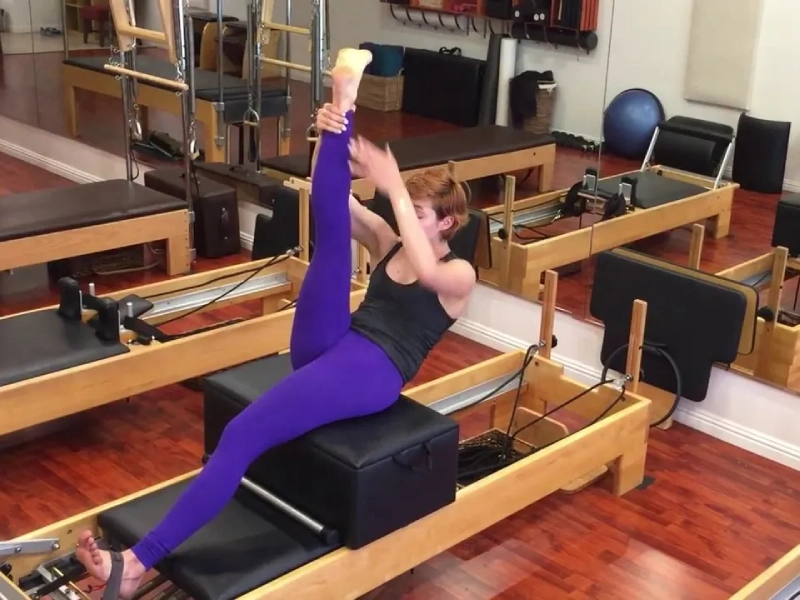
The Pilates Tree exercise on the Reformer is more flexible and suitable for taller individuals.
Hip flexor length and tension
If hip flexors are tight, starting with the Spine Corrector or Ladder Barrel is recommended, as they allow better control and reduced strain. The Reformer offers deeper stretch but may overload the hip flexors if flexibility is limited.
Foot and ankle strength
The Ladder Barrel allows foot pressure against the ladder for stability. The Reformer requires sufficient ankle and foot strength to maintain balance in the strap. The Spine Corrector places minimal demand on ankle strength, making it suitable for beginners or rehabilitation.
Tendency for hip flexor cramping
If hip flexor cramping is common, the Ladder Barrel is often the best option. Pressing the heel into the ladder activates hip extensors and reduces excessive hip-flexor engagement. The Spine Corrector also reduces anterior hip tension, while the Reformer may overstimulate this area if control is insufficient.
The Pilates Tree exercise on the Reformer, Ladder Barrel, and Spine Corrector offers significant benefits for spinal health, flexibility, and body control. Choosing the right apparatus allows practitioners to approach the Tree exercise safely, confidently, and effectively. Always listen to your body, respect your current level, and follow a structured, sustainable training progression.