

Pilates Rolling Like a Ball Exercise Overview: How to Perform, Benefits, and Variations
24/12/2025Pilates Rolling Like a Ball exercise, also known as Rolling Back, is one of the fundamental yet highly effective exercises in the Pilates method. This movement not only strengthens the abdominal muscles but also improves balance and flexibility. Let’s explore this exercise in detail to better understand how it contributes to enhancing overall health and physical fitness.
What Is the Pilates Rolling Like a Ball Exercise?
Today, many trunk focused exercises are excellent for strengthening the abdominal muscles but do not necessarily promote a healthy spine. Rolling Like a Ball, like many other Pilates movements, addresses both of these aspects simultaneously. So, what exactly is the Rolling Like a Ball exercise?
Rolling Like a Ball (literally translated as “rolling like a ball”), also known as Rolling Back, is a original Pilates Exercises that focuses on strengthening the abdominal muscles, improving body control, and supporting spinal mobility. In this exercise, the practitioner sits in a compact, rounded position resembling a ball, gently rolls backward, and then returns to the starting position, with all movement controlled entirely by the abdominal muscles.
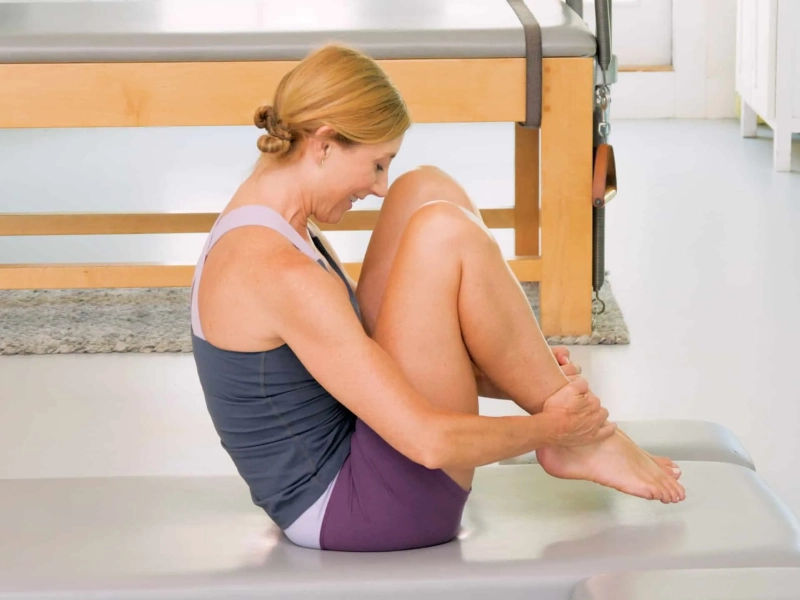
Pilates Rolling Like a Ball exercise also known as Rolling Back.
This movement not only provides a gentle massage along the spine but also trains balance, core stability, and coordinated muscle engagement. As you roll, the lower abdominals contract to slow the movement, allowing each vertebra to articulate independently and with control, thereby enhancing spinal health and core strength.
Primary muscle groups engaged include:
- Abdominal muscles: Rectus abdominis, external obliques, internal obliques, and transversus abdominis.
- Supporting muscles: Hip flexors and extensors, hip adductors, knee extensors, shoulder extensors, and elbow flexors.
Rolling Back is commonly used as part of a Pilates mat sequence to prepare the body for more complex movements, while also improving body awareness and neuromuscular coordination. To increase difficulty and deepen technique, the exercise can be performed with a Pilates ring (Magic Circle) or on a Spine Corrector to enhance stability and activate deeper muscles.
Step by Step Guide to Performing Rolling Like a Ball
Follow these steps to perform the Rolling Like a Ball exercise on the mat:
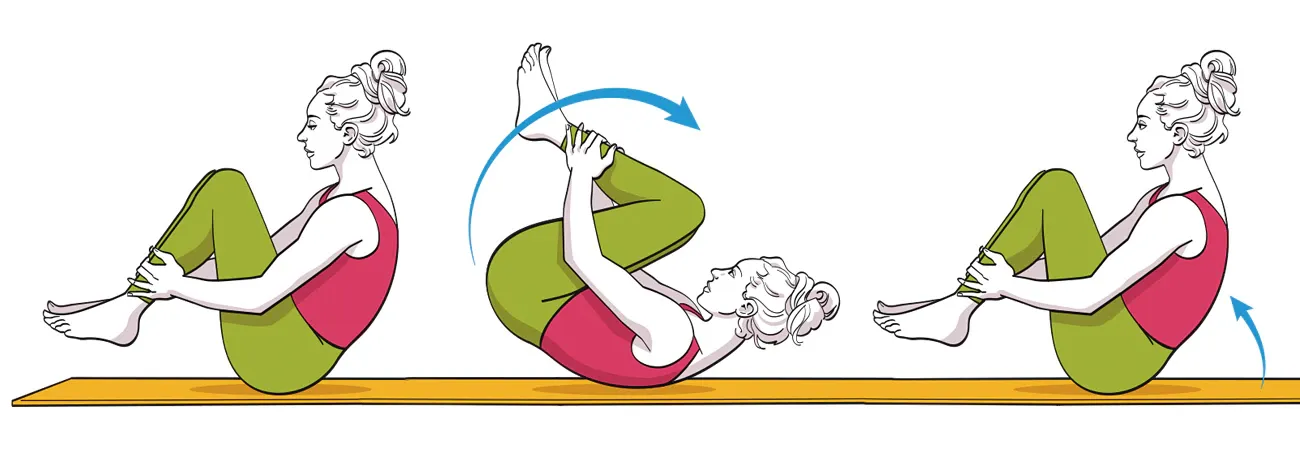
How to perform the Rolling Like a Ball exercise.
- Step 1: Sit at the front of the mat with an upright spine. Bend your knees and hold your ankles or shins with both hands. Lift both feet off the floor, keeping the knees open to the sides and the heels gently pressed together.
- Step 2: Round your spine, slightly tucking the chin toward the chest to protect the neck without tensing it. Direct your gaze toward the heels or the center of the body. Balance on the tailbone this is your starting position.
- Step 3: Create opposition by pressing the shins into the hands and the hands back into the shins. Feel the connection between the upper and lower body. At the same time, imagine pushing the thighs forward and drawing the abdominals inward, similar to the Stomach Massage exercise on the Reformer.
- Step 4: Inhale and slowly roll backward until you reach the shoulder blades (do not roll onto the neck). Exhale and use the abdominal muscles to roll back up to the starting position, maintaining balance without letting the feet touch the floor. Avoid collapsing or using momentum.
- Step 5: Perform 6–10 repetitions, keeping the movement smooth, rounded, and controlled. Each roll should feel like a steady, even motion of a ball rather than a jerky or forced movement.
Pilates Rolling Like a Ball with a Ring
When combined with a Pilates ring (Magic Circle), the Rolling Like a Ball exercise offers a new level of challenge, enhancing coordination and balance. Here’s how to perform this variation:
Step 1: Set up the starting position
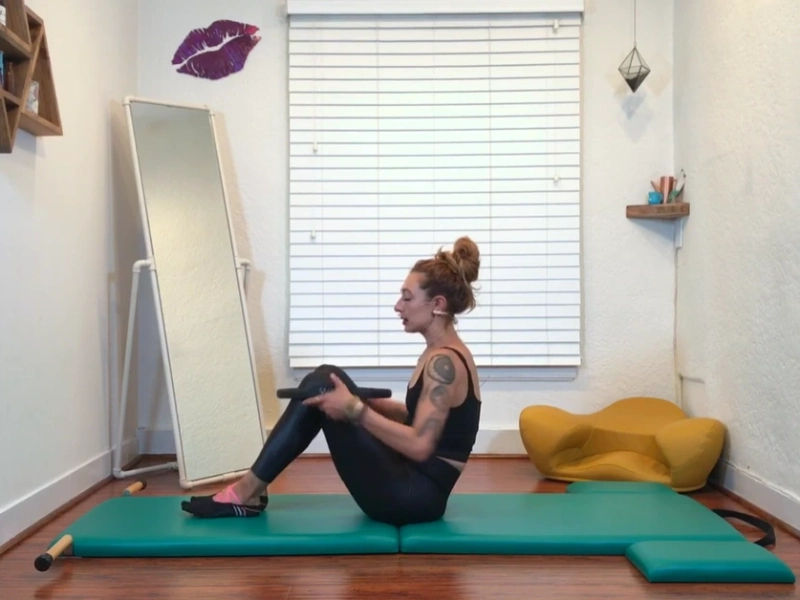
Starting position.
- Sit on the Pilates mat with knees bent and feet lightly resting on the floor.
- Hold the Pilates ring in an appropriate position depending on your training goal (between the knees, between heels and hips, or in the hands).
- Place your weight on the sitting bones and keep the spine gently rounded into a “C” shape. Inhale deeply and relax the shoulders.
Step 2: Begin spinal rolling with the Pilates ring
- To activate the outer hips: Place the ring around the knees and gently press outward as you roll to engage the outer hip muscles.
- To enhance inner thigh control: Place the ring between the knees and gently squeeze it during the roll to activate the inner thighs.
Step 3: Perform the rolling motion
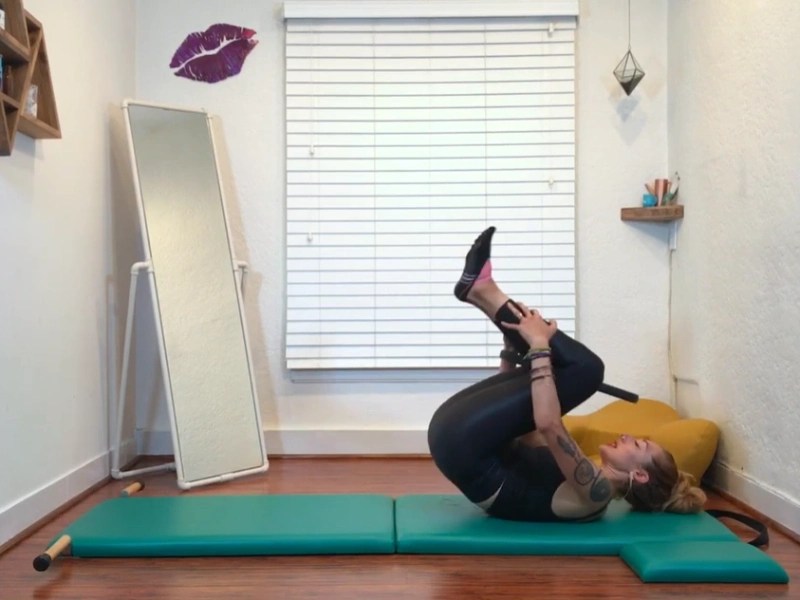
Perform the Rolling Like a Ball exercise with the Pilates hoop.
- Lift the feet off the floor, keeping them close together with the heels drawn toward the hips.
- Begin rolling backward by gently articulating the tailbone, maintaining proper ring placement. Keep the center stable and ensure the Pilates ring remains under control throughout the movement.
- Roll forward to return to the starting position, maintaining balance without letting the feet touch the mat.
Step 4: Advanced variations
- Arm leg connection: Hold the Pilates ring in the hands with elbows touching the knees. Roll
- without allowing the elbows to separate from the knees, increasing core activation.
- Ring behind the heels: Place the ring between the heels and hips, ensuring it does not slip during the roll. This variation improves stability and muscular coordination.
Important notes:
- Maintain steady breathing with each roll to maximize effectiveness. Avoid squeezing the Pilates ring too forcefully to preserve control.
- In group classes, be mindful that the ring may slip if control is lost.
Pilates Rolling Like a Ball on the Spine Corrector
Performing Rolling Like a Ball on a Spine Corrector helps open the chest, reduce spinal tension, and increase flexibility. This variation is particularly beneficial for those who struggle to maintain a rounded shape or have limited spinal mobility.
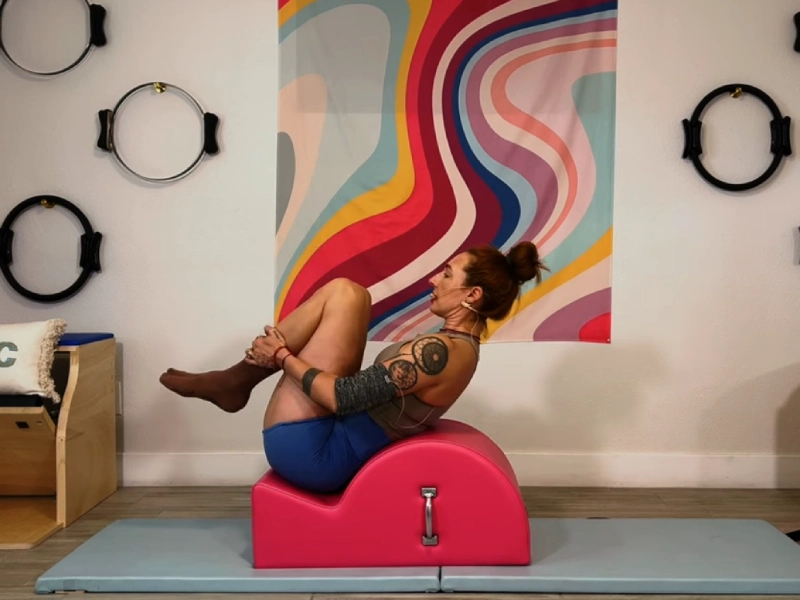
Steps to perform the Pilates Rolling Like a Ball exercise on a Spine.
Step by step instructions:
- Sit on the Spine Corrector with the pelvis positioned at the center of the apparatus, allowing the lower back to gently rest against its curve.
- Bend the knees, drawing them toward the chest, and keep the feet slightly lifted off the ground. Place the hands around the shins or knees for support.
- Gently lower the head, drawing the chin toward the chest to keep the neck relaxed and tension free. Engage the abdominals and stabilize the center to maintain balance.
- Inhale deeply and begin rolling backward, maintaining a rounded shape from head to spine.
- The Spine Corrector supports the lower back, making the rolling motion smoother. Exhale and slowly roll back up to the starting position, using the abdominal muscles to control the movement and maintain balance without letting the feet touch the floor.
- Perform 6-8 repetitions, focusing on controlled breathing and ensuring each roll is initiated from the core rather than the arms or legs.
Common Mistakes When Performing Rolling Back
- Losing balance during the roll: Focus on engaging the abdominal muscles and keeping the knees close to the chest to stabilize the body.
- Neck tension: This often occurs when pulling the head forward excessively. Relax the neck and keep the chin gently drawn toward the chest without strain.
- Using momentum instead of muscle control: Slow down the movement and concentrate on controlling the roll with the abdominals rather than relying on inertia.
- Lack of core focus: Maintain a clear “C” curve through the center of the body to ensure the core muscles are fully engaged throughout the exercise.
With detailed guidance from the starting position to advanced variations, the Pilates Rolling Like a Ball exercise is sure to become an essential part of your daily training routine. It not only strengthens the abdominal muscles but also helps you gain better body control and confidence in every movement. If you have any questions, do not hesitate to seek guidance from Pilates professionals. Wishing you enjoyable and effective training sessions on your journey to better health.