

Pilates Crab Exercise: What It Is, How to Perform It, and Important Safety Tips
06/01/2026For Pilates enthusiasts, The Crab is one of the classic movements that should not be overlooked. This unique exercise helps build core strength and enhance overall flexibility. Let’s explore in detail how to perform the Pilates Crab exercise and the positive effects it offers.
What Is the Pilates Crab Exercise?
The Pilates Crab exercise is one of the 34 original classical mat exercises created by Joseph Pilates. Performed on a mat, the movement mimics the rounded, rolling motion of a crab. Specifically, the exercise requires the practitioner to curl the body, draw the knees tightly toward the chest, cross the legs, and form a deep C-curve in the spine while rolling backward. From there, the body returns smoothly and with control to the starting position.
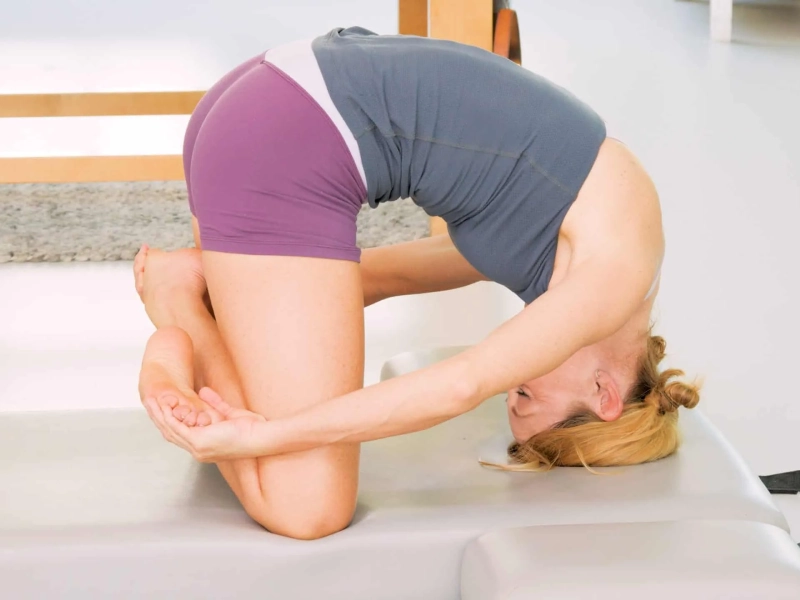
The Crab is one of the 34 Pilates mat exercises originally created by Joseph Pilates.
The primary goal of the Pilates Crab exercise is to increase spinal flexibility, improve deep abdominal control, and train balance. This is considered an advanced exercise because it involves rolling onto the shoulders and demands a solid foundation in Pilates technique.
Benefits of the Pilates Crab Exercise
Incorporating The Crab into Pilates workouts provides numerous benefits, including:
- Strengthens core muscles: The Crab strongly engages the central muscle groups, including the abdominals, obliques, and pelvic stabilizers. This helps reinforce the body’s axis and supports a healthier spine during daily movement.
- Improves shoulder and upper body stability: During the rolling motion, the shoulders are continuously activated, enhancing endurance, mobility, and postural alignment in the upper body.
- Enhances hip and spinal flexibility: The Pilates Crab exercise stretches and improves mobility in the hips and along the entire spine. It also delivers a gentle massage to the mid and upper back while lengthening the muscles along the back of the neck, especially in advanced versions.
- Develops coordination and movement control: The requirement to roll evenly, switch leg crosses, and return precisely to the starting position sharpens body awareness, improves movement accuracy, and strengthens the mind body connection.
- Promotes full body coordination: The Crab requires multiple muscle groups to work together core, hips, shoulders, arms, and legs helping the body move efficiently and build balanced, sustainable strength.
Target Muscle Groups in the Pilates Crab Exercise
The Pilates Crab exercise focuses on activating the abdominal and spinal muscles to enhance trunk control and core stability. Key muscles involved include:
- Rectus abdominis, responsible for trunk flexion
- External and internal obliques, supporting rotation and stabilization
- Transversus abdominis, a deep core muscle essential for spinal protection and lower abdominal stability
In addition, several supporting muscles assist throughout the movement, such as the hip flexors and extensors, hip adductors, knee extensors, shoulder extensors, and elbow flexors. This full body coordination not only improves movement control but also boosts flexibility and overall core strength.
How to Perform the Pilates Crab Exercise
To practice the Pilates Crab exercise, follow these steps:
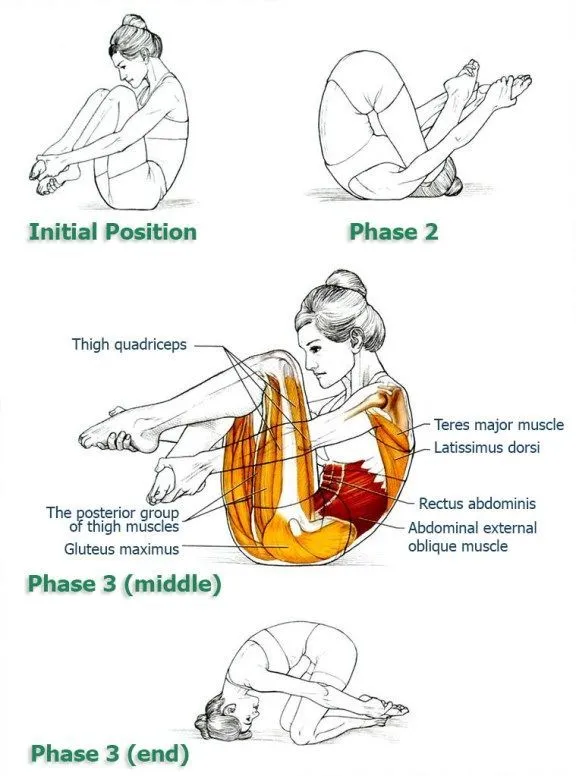
How to perform the Pilates Crab exercise.
- Begin seated upright on the mat with your knees bent and legs crossed. Hold onto your toes with both hands.
- Flex the spine forward, curling into a ball. Gently place the crown of the head toward the mat while drawing the abdominals in deeply, as if hugging yourself.
- Inhale and use your abdominal muscles to roll backward. Allow the back to contact the mat, stopping when the shoulders touch, avoid placing weight on the head or neck.
- While rolled back, switch the leg cross (bring the top leg underneath). Then roll forward to return to the starting position, lightly touching the head to the mat as before.
- Repeat 4-5 times, moving smoothly and evenly like a rolling ball, without using momentum or force.
Versions and Variations of the Pilates Crab Exercise
Beyond the traditional execution of the Pilates Crab exercise, several versions and variations can be used to match individual goals and ability levels.
Classical Versions
There are two main versions described in classical Contrology texts. One version remains unchanged and is repeated up to six times. The second version requires shifting weight forward onto the knees, lifting the pelvis as the crown of the head reaches the mat, and carefully lengthening the back of the neck while maintaining body weight on or just behind the knees, before returning to the top position.
Although the original descriptions do not specify changing the leg cross, most practitioners today switch leg positions after three repetitions or each time they return to the shoulders.
Traditional Advanced Variation
In traditional Pilates, the version of The Crab that rolls into a head balance is classified as advanced. This variation challenges strength, balance, spatial awareness, and proprioception. Rolling toward the head demands maximum control and precise alignment to avoid neck strain and maintain stability throughout the movement.
Modern Variations
While the traditional head rolling version remains part of some Pilates repertoires, modern adaptations prioritize safety and biomechanics. Pilates instructors often provide modifications and progressions tailored to individual needs.
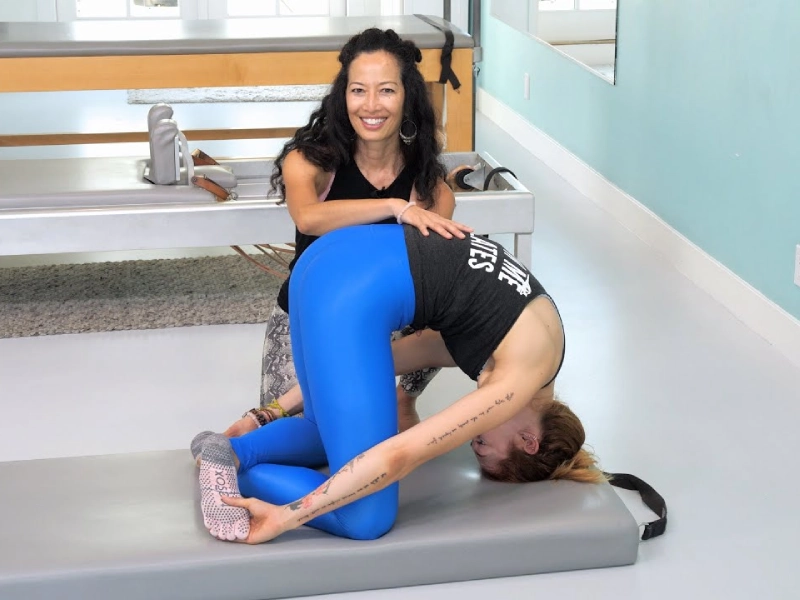
Pilates Crab has many different versions and variations.
For example, practitioners may choose to support the movement on the shoulders only, avoid head contact with the mat, or use props to assist the motion and reduce injury risk. Another variation involves different arm and hand placements. Two traditional options include:
- Positioning the arms inside the thighs and reaching under the knees to grasp the outside of the feet.
- Placing the arms outside the legs while still holding the instep and ankle.
Modern adaptations often allow holding the toes or the front of the feet, increasing accessibility and flexibility.
Important Notes When Practicing the Pilates Crab Exercise
Although the Pilates Crab exercise offers significant benefits for core control and strength, it is not suitable for everyone. The following cases should limit or avoid this exercise:
- Not suitable for those contraindicated for spinal flexion or inversion: The exercise involves deep spinal flexion and rolling backward, which may aggravate existing spinal conditions.
- Avoid if you have neck issues or a history of injury: While the head only lightly touches the mat, the movement may still affect individuals with neck pain, cervical degeneration, or head and neck injuries.
- Not recommended if proper abdominal activation is lacking: The exercise requires deep core engagement. Insufficient control can lead to imbalance or injury.
- Advice: Before attempting the Pilates Crab exercise, consult a qualified instructor or healthcare professional if you have any concerns related to your back, neck, or abdominal muscles to ensure safe practice.
Incorporating the Pilates Crab exercise into your regular routine can be a powerful step toward a stronger, more balanced body. Beyond improving physical fitness, this exercise helps de your connection with your body. Try it and experience the unique benefits that The Crab brings to your Pilates practice.