

A Complete Guide to the 34 Original Pilates Exercises
23/12/2025With more than a century of development, Pilates has become one of the most popular and effective exercise methods worldwide. In particular, the 34 original Pilates exercises created by Joseph Pilates have been proven to deliver outstanding benefits for both health and physical fitness. Let’s explore each step in detail so you can confidently begin your Pilates journey, especially if you are a beginner.
Overview of the 34 Original Pilates Exercises
Today, there are many different forms of Pilates, such as Mat Pilates, Reformer Pilates, Wall Pilates, or even combinations of Yoga and Pilates. However, the true foundation of this method lies in the 34 original Pilates exercises presented by Joseph Pilates in his book Return to Life Through Contrology.
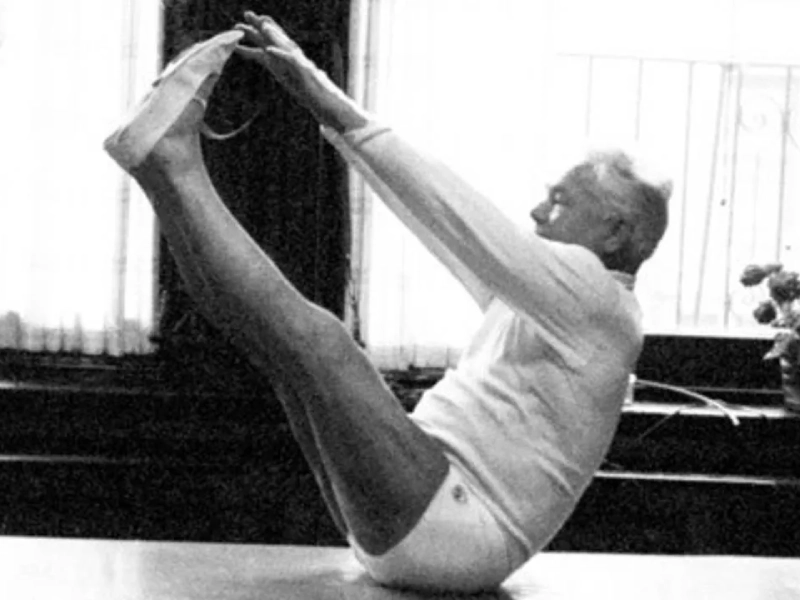
The 34 original Pilates exercises are described in detail in the book Return to Life of Joseph Pilates.
Joseph Pilates, together with his partner Clara, began teaching this method in New York City in the 1920s. At that time, he called it Contrology-the art of controlling the body. In his book, he wrote:
“If you faithfully follow the Contrology exercises exactly as outlined in Return to Life for only four periods of four weeks, you will find your body development approaching the ideal, accompanied by renewed mental vigor and spiritual enhancement.”
If you love traditional Pilates or are drawn to structured, fixed-sequence workouts, this classical set of 34 movements will offer an exceptional experience. Joseph Pilates emphasized that these exercises must be performed in the exact order, without modification or omission, as each movement is closely connected to the next.
He placed great importance on the mind’s control over the muscles, stating: “Contrology begins with control of the mind over the body.”
This method requires determination and consistency, but in return, it restores mental clarity, improves flexibility, and builds a stronger, healthier body. As Joseph Pilates himself described it: “It is the complete coordination of body, mind, and spirit.”
How Are the Original Pilates Exercises Different from Modern Pilates?
Although both are rooted in the philosophy of Joseph Pilates, original Pilates and modern Pilates differ significantly in approach and training goals.
| Criteria | Classical Pilates (Original Pilates) | Contemporary Pilates (Modern Pilates) |
| Origin | Fully based on the original exercise system created by Joseph Pilates | Developed from the original system, incorporating various modern approaches |
| Exercise Structure | Consists of 34 mat-based exercises performed in a fixed, continuous sequence | Flexible sequence and number of exercises, adjusted to goals and practitioner level |
| Original Principles | Preserves 100% of the original Contrology principles | Allows modification or creative variations of exercises |
| Movement Flow | Continuous movement with no breaks between exercises | May include pauses, rest time, or movement adjustments |
| Training Goal | Build deep internal strength and total body control | Serves diverse goals: rehabilitation, flexibility, pain relief, fitness, etc |
| Level of Challenge | High; requires strong discipline, focus, and control | Adjustable for beginners or individuals with health limitations |
| Support Equipment | Primarily mat-based, no equipment required | May use props such as balls, rings, Reformer machines, foam rollers, etc |
| Suitable Participants | Intermediate to advanced practitioners seeking traditional, in-depth practice | Suitable for a wide range of participants, including those in rehabilitation |
| Practical Application | Easy to practice at home without complex equipment | Commonly practiced in studios equipped with specialized apparatus |
In summary: while modern Pilates can be seen as a more accessible, widely adapted version for diverse audiences, the 34 original Pilates exercises represent the pure essence of the method, preserving the full philosophy and effectiveness that Joseph Pilates carefully developed.
How to Perform the 34 Original Pilates Exercises
Joseph Pilates designed these 34 exercises to be practiced in a precise sequence that he believed to be logical and effective. The idea is to first warm up the body, then gradually move into more challenging exercises once the body is fully prepared.
The sequence then progresses toward cooling-down movements before the session ends. This structure ensures that all areas of the body are targeted in multiple positions initially working with gravity and body weight, and later working against it.
The exercises are classified into three levels: basic, intermediate, and advanced. In practice, movements are often broken down into preparatory steps depending on the practitioner’s level, gradually progressing to the full version once readiness is achieved.
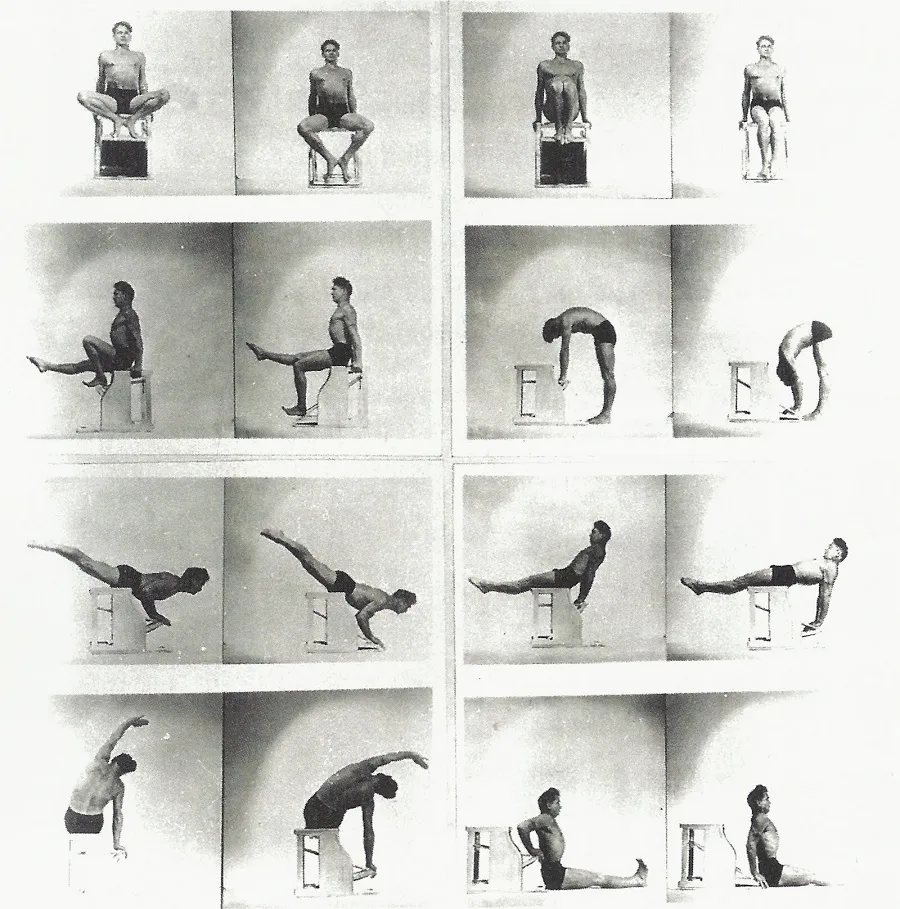
Instructions for performing the 34 original Pilates techniques.
The complete list of the 34 original Pilates exercises includes
(Click on each exercise to view detailed instructions):
- The Hundred
- The Roll-Up
- The Roll-Over
- The One-Leg Circle
- Rolling Like a Ball
- The One-Leg Stretch
- The Double-Leg Stretch
- The Spine Stretch
- Rocker with Open Legs
- The Cork-Screw
- The Saw
- The Swan-Dive
- The One-Leg Kick
- The Double-Leg Kick
- The Neck Pull
- The Scissors
- The Bicycle
- The Shoulder Bridge
- The Spine Twist
- The Jack-Knife
- The Side Kick
- The Teaser
- The Hip Twist with Stretched Arms
- Swimming
- The Leg Pull-Front
- The Leg Pull-Back
- The Side Kick-Kneeling
- The Side Bend
- The Boomerang
- The Seal
- The Crab
- The Rocking
- The Control Balance
- The Push-Up
You may follow the exercises strictly in order or select movements from the list according to your current level.
Benefits of the 34 Original Pilates Exercises
Practicing the 34 original Pilates exercises, rooted in the original concept of Contrology, allows us to experience the true essence of Pilates. This system enhances spinal mobility, strengthens the core, and supports daily activities with greater ease and comfort.
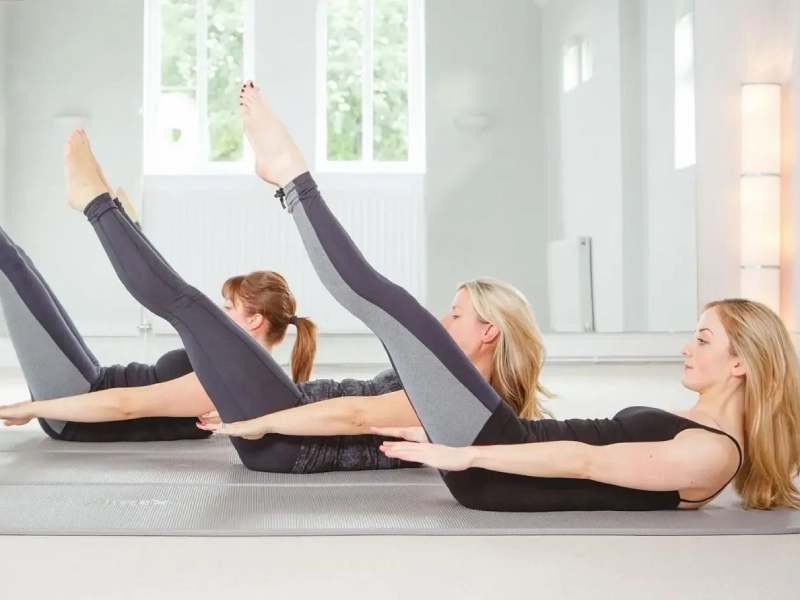
It is helpful to perform the 34 original Pilates poses.
1. Build muscular strength
Pilates focuses on developing deep muscle strength, especially the core muscles such as the abdominals, lower back, and hips. Exercises like The Hundred, Roll-Up, and Teaser help tone and strengthen muscles evenly, improving overall body strength.
2. Improve flexibility and balance
Pilates demands a high level of flexibility and balance. Movements such as Spine Stretch Forward and the Side Kick Series lengthen and loosen muscles, enhancing flexibility. At the same time, exercises like Shoulder Bridge and Push-Up improve balance, making the body more agile and controlled.
3. Reduce stress and enhance mental well-being
One of the core principles of Pilates is breath control combined with mental focus. Regular practice helps reduce stress and anxiety while improving mental clarity. Exercises such as Roll Over and Swimming promote relaxation and a sense of calm after each session.
4. Enhance focus and body control
Pilates requires intense concentration and precise movement control. Completing the full sequence of the 34 original Pilates exercises trains your ability to focus and control your body more effectively, leading to increasingly accurate and efficient movement over time.
5. Improve posture and reduce back pain
Many Pilates exercises are designed to correct and improve posture. Movements like Spine Stretch Forward and Shoulder Bridge strengthen and lengthen the back muscles, helping improve posture and alleviate back pain. Practicing all 34 exercises regularly promotes a taller, more aligned posture and reduces the risk of spinal issues.
6. Support cardiovascular health
Although Pilates is not a high-intensity workout like running or aerobics, its continuous and rhythmic movements still positively impact cardiovascular health by improving blood circulation and supporting heart function.
7. Develop full-body coordination
Pilates emphasizes coordinated movement between muscle groups and synchronized breathing. This enhances overall body coordination, making daily activities and other forms of exercise more efficient and controlled.
Practicing the 34 original Pilates exercises consistently and correctly not only improves overall health but also enhances flexibility and builds lasting strength. Stay committed, listen to your body, and fully enjoy the benefits that Pilates has to offer.