

What Is the Pilates Horseback Exercise? How to Perform It and Important Considerations
16/01/2026The Pilates Horseback exercise is a movement within the Pilates repertoire that helps strengthen the core, improve posture, and enhance overall body control. However, to practice it correctly and effectively, practitioners need a clear understanding of how it is performed on specific Pilates equipment such as the Reformer, Ladder Barrel, and Wunda Chair. This article will help you understand what the Pilates Horseback exercise is, how to perform it properly, and the important considerations you should not overlook.
Overview of the Pilates Horseback Exercise
The Horseback exercise is a classic movement in the Pilates method, designed to train body control, improve posture, and strengthen the core muscles. The term “Horseback” comes from the visual image of the body resembling someone sitting astride a horse, with an upright spine, engaged abdominals, and legs opened at hip width.
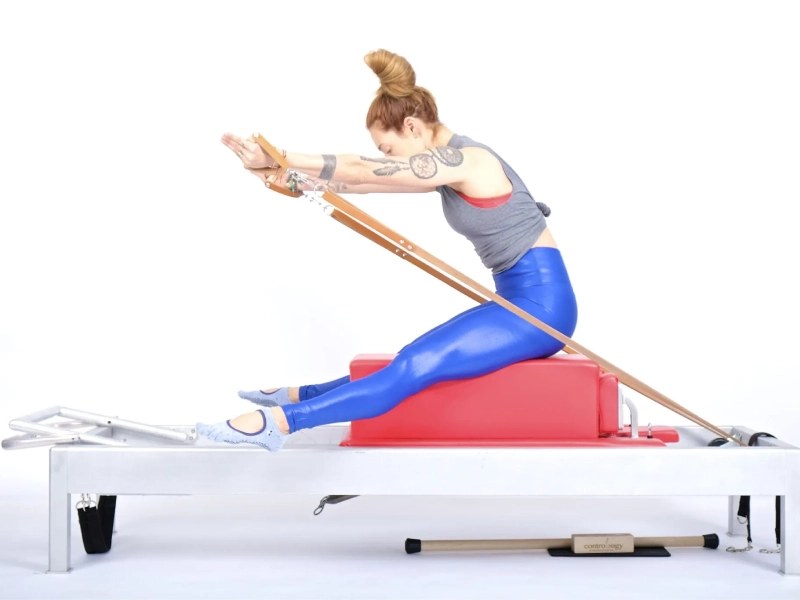
Pilates Horseback Exercise on the Reformer.
This exercise helps to improve:
- Deep activation of the transverse abdominis and other core muscles.
- Strength in the lower back, glutes, inner thighs, and upper body control.
- Upright posture and spinal control.
- Coordination and breath control.
- Overall flexibility and balance of the body.
The Pilates Horseback exercise ranges from intermediate to advanced, depending on the equipment used. It is most commonly performed on the Wunda Chair, Ladder Barrel, and Reformer.
Pilates Horseback on the Wunda Chair
The defining feature of the Pilates Horseback exercise on the Wunda Chair is the seated position with the body slightly leaning forward, hands firmly placed on the Chair handles, while the legs remain wide and extended. Through rhythmic lifting and lowering of the body, this exercise requires not only strength but also precise control from the core muscles.
Although it may appear simple at first glance, the Horseback on the Wunda Chair demands accuracy in every small detail of movement and breath, helping practitioners achieve an optimal connection between body and mind.
How to Perform the Pilates Horseback Exercise on the Wunda Chair
1. Starting position
- Sit upright, ensuring the legs are not excessively externally rotated. Focus on feeling the connection from the center of the body to the inner thighs and hips.
- The goal is to maintain a parallel alignment, emphasizing length through the center rather than height, extending from the core through the arms and legs.
2. Roll the body forward
- Curl the torso forward while pointing the toes.
- Place both hands on the pedal, keeping the hips slightly lifted off the seat.
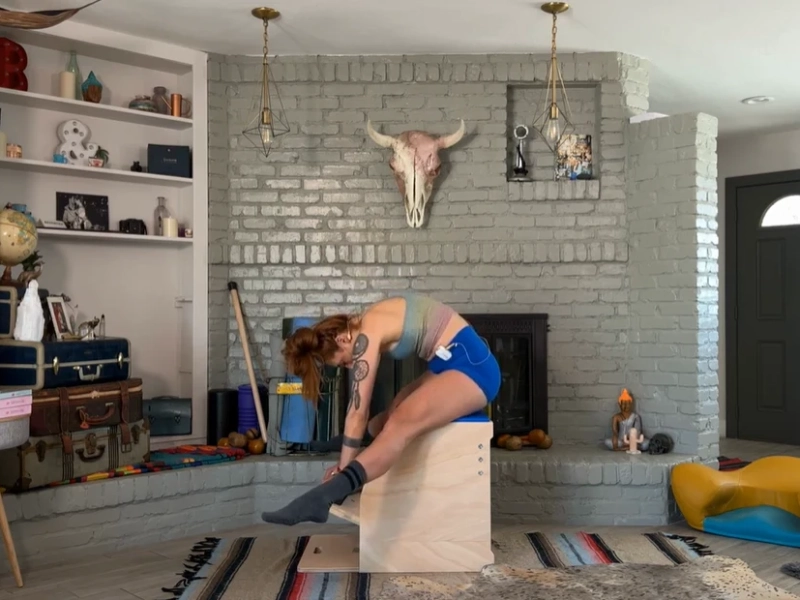
Perform the Pilates Horseback Exercise on the Wunda Chair
3. Move the pedal
- Gently press the pedal down while maintaining a rounded spine.
- Lift the pedal back up using core strength rather than relying solely on the arms.
- Repeat the pressing and lifting motion 3-5 times.
4. Return to the starting position
- Slowly lift the body back to the upright seated position, flex the feet, and raise the arms overhead.
- Repeat the entire sequence 2-3 times.
Pilates Horseback on the Ladder Barrel
In the Horseback exercise on the Ladder Barrel, the practitioner sits on the curved surface of the Barrel and performs spinal flexion and lengthening movements similar to the “horseback riding” posture, requiring smooth coordination between body movement and breath.
The uniqueness of this variation lies in the Ladder Barrel’s structure, which both supports and challenges the practitioner. The curved surface helps maintain proper alignment and allows for greater spinal mobility, while also demanding high concentration to maintain balance.
How to Perform the Pilates Horseback Exercise on the Ladder Barrel
Step 1: Preparation
- Sit on the curved surface of the Ladder Barrel with an upright spine.
- Extend both legs forward and lift them so they are nearly parallel to the floor.
- Flex the feet and gently hug the legs into the lower rung of the Barrel.
- Place both hands at the hip crease, palms facing upward.
Step 2: Create the “Horseback” position
- Use the inner thighs and outer hips to hug the Ladder Barrel.
- Transition the feet from flexed to pointed.
- Reach the arms forward from the shoulders, palms facing up, while maintaining a rounded spine.
- As the spine stays rounded, the hips may lift slightly off the Barrel.
Note: If you need to lower the legs to lift the hips, stay flexible through the ankles, sit back onto the Barrel, and restart the movement.
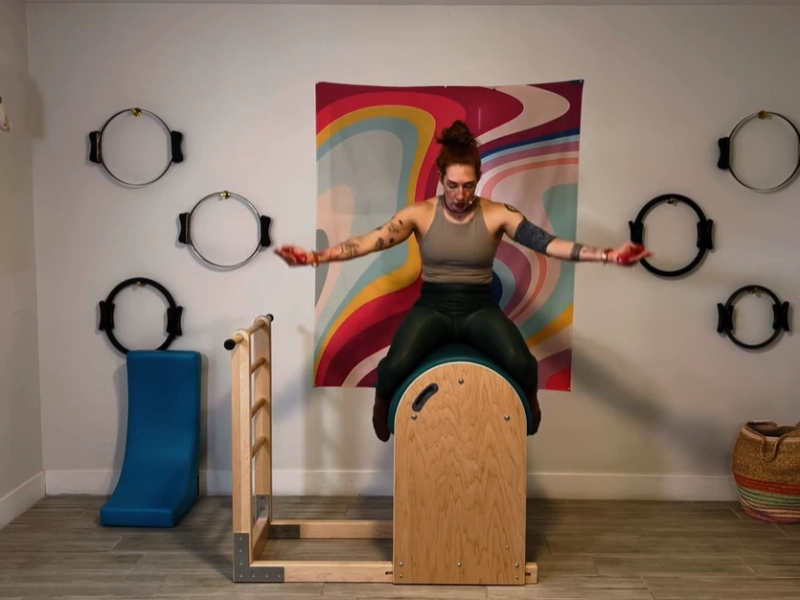
Perform the Pilates Horseback Exercise on the Ladder Barrel.
Step 3: Arm movement
- Circle the arms up and back, performing three large circles with the palms facing downward.
- After completing three circles, return the arms to the starting position and sit upright on the Ladder Barrel.
Step 4: Control the hips and spine
During execution, the hips may lift slightly. However, it is essential to keep the spine rounded and not sacrifice proper alignment just to lift the hips higher.
Step 5: Repeat
Repeat the movement for the desired number of repetitions. Once you are comfortable with the basic version, you may progress to more advanced variations with fully extended legs or move on to another apparatus such as the Reformer.
Pilates Horseback on the Reformer
The Horseback exercise on the Reformer is an advanced Pilates movement that emphasizes core strength and balance. In this variation, the practitioner sits on the Reformer with legs open and hands holding the straps. From this position, movements similar to the horseback posture are performed, using core engagement to maintain balance and control throughout the exercise.
Step by Step Guide to Performing the Pilates Horseback Exercise on the Reformer
Reformer setup: Adjust the straps to a moderate resistance suitable for your ability level. Ensure the Reformer is stable and secure before starting.
Starting position: Sit on the Reformer with legs open, holding the straps, maintaining an upright spine and lengthened posture.
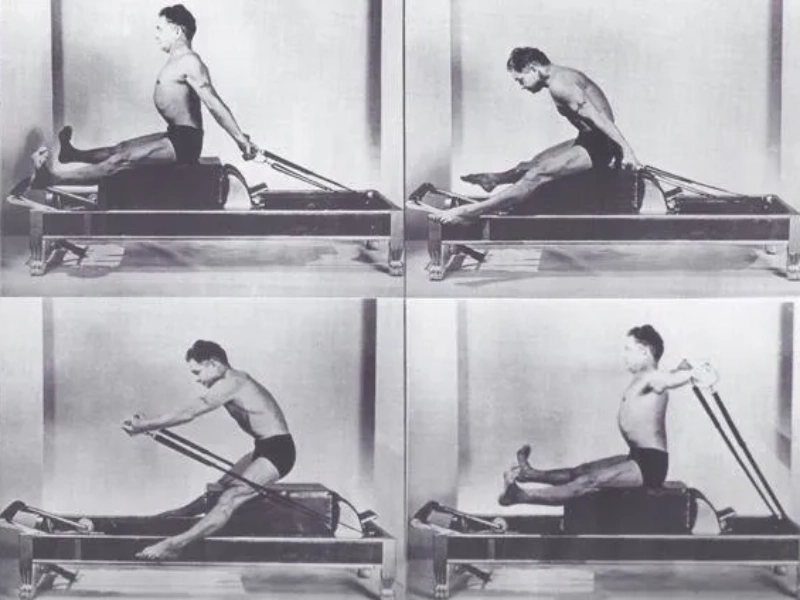
Perform the Pilates Horseback Exercise on the Reformer.
Execution:
- Place the hips at the center of the Reformer carriage, legs extended and wider than shoulder width. Hold the straps with palms facing each other, arms extended forward.
- Lengthen the spine from hips to head, keeping the neck and head in a neutral position without excessive extension or flexion.
- Begin pulling the straps backward while bending the elbows, keeping the upper arms close to the body. Inhale deeply as you prepare for the main movement.
- Engage the core to lift the hips off the carriage while continuing to pull the straps back, creating a curve from hips to shoulders. The body should resemble a horseback riding position, supported by abdominal and back muscle control.
- Exhale as you return to the starting position, lowering the hips and bringing the arms forward. Perform the movement slowly and with control, focusing on spinal alignment and avoiding excessive spinal rounding.
Safety Considerations When Performing the Horseback Exercise
While the Pilates Horseback exercise is an excellent method for improving posture, core strength, and body control, performing it incorrectly can lead to fatigue, discomfort, or reduced effectiveness. Keep the following points in mind for safer and more effective practice:
Common mistakes:
- Rounded shoulders and excessive neck flexion: When the shoulders lift or the neck collapses, the natural length of the body is lost, increasing tension in the neck and shoulders.
- Lack of lift from the abdominals and chest: Without proper lift, the body can collapse and lose balance.
- Over gripping with the thighs: Relying on the thighs instead of the core reduces fluidity and creates stiffness.
- Failure to properly engage the abdominals: This shifts excessive load to the lower back, increasing the risk of discomfort or strain.
Who should avoid this exercise?
- Individuals with spinal injuries or acute conditions such as severe disc herniation.
- Individuals experiencing pelvic pain, or postpartum women with weak abdominal muscles, who should consult a specialist before practicing.
- Beginners who are new to Pilates or lack control in foundational exercises should build a strong base before attempting this movement.
Hopefully, this article has given you a clearer understanding of the Pilates Horseback exercise and how to perform it correctly on the Reformer, Ladder Barrel, and Wunda Chair. Remember that success with this exercise comes not only from precise technique but also from patience and consistent practice. Incorporate this exercise into your training routine to experience positive changes in both your body and overall well being.