

Pilates The Saw Exercise: Everything You Need to Know
29/12/2025For Pilates enthusiasts, the Pilates The Saw exercise is a familiar movement. It is designed to stretch the body and improve overall flexibility. If you want to learn more about the Pilates The Saw exercise from proper execution to the benefits it offers this article is for you.
What Is the Pilates The Saw Exercise?
The Saw is one of the 34 original exercises created by Joseph Pilates, holding the eleventh position in the classical sequence. In Classical Pilates, you perform The Saw right after Corkscrew, and once completed, you transition using a favorite transitional movement into a prone position for the Swan exercise.
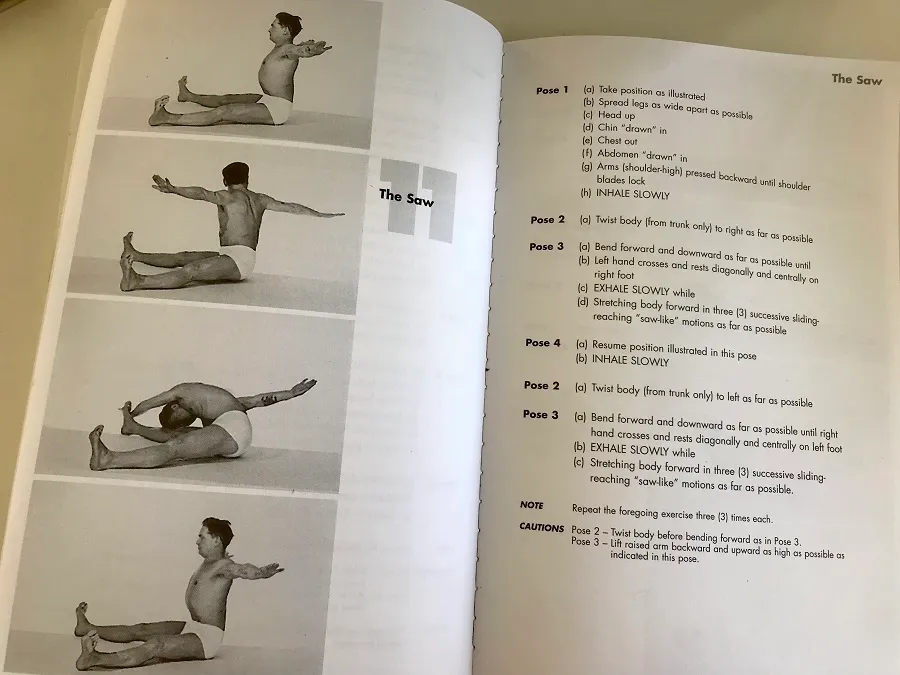
The saw is one of the 34 original exercises of Joseph Pilates.
The Saw is a seated exercise that combines the spinal flexion of Spine Stretch with the rotation of Spine Twist. It moves through all three planes of motion sagittal, transverse (horizontal), and coronal (frontal) which can make it feel slightly complex in terms of choreography. As with most Pilates exercises, there are many elements to consider, but they can be simplified.
How to Perform the Pilates The Saw Exercise
The Saw is an excellent Pilates Mat exercise for training trunk rotation and abdominal strength while stretching the back muscles and hamstrings. The opposing pull one arm reaching forward while the rib cage and pelvis draw back helps lengthen the entire posterior chain. The Saw also teaches pelvic stability, as the abdominal muscles work to keep the pelvis stable while the upper body moves dynamically.
Follow these steps to master the Pilates The Saw exercise:
- Begin by sitting tall, as if your back were against a wall. Extend your legs forward and open them slightly wider than shoulder width. Knees and toes point toward the ceiling, while the heels reach away from you to create length and opposing energy.
- Lift both arms out to the sides at shoulder height, fingertips reaching outward and palms facing down. Gently slide the shoulder blades down the back to create space between the neck and shoulders.
- Take a deep inhale. As you exhale, flex the head and neck, then the upper spine, rolling down the imaginary wall while drawing the abdominals inward. Continue to lengthen forward and rotate to the right. The left arm and fingertips reach toward the little toe of the right foot. The right arm reaches back behind you, palm facing upward. As in Spine Stretch, you are flexing over a rounded barrel toward your toes.
- Inhale as you roll back up the “wall” starting from the tailbone, then the lower back, upper back, neck, and head, returning to the starting position feeling taller than before.
- Repeat steps 3 and 4 to the opposite side, with the right arm reaching toward the little toe of the left foot.
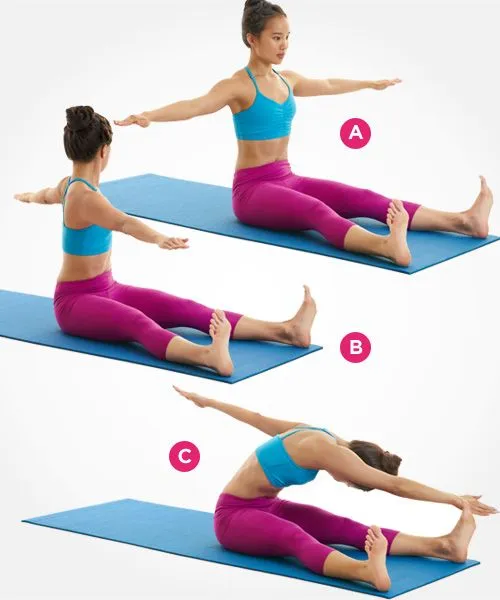
Steps to master the Pilates The Saw exercise.
Key Points to Remember When Practicing Without Supervision
- Initiate the lift from the hips, moving along the spine and out through the crown of the head.
- Soften the chin to help maintain a tucked tailbone during movement.
- Sit evenly on both sit bones throughout the exercise.
- Imagine slicing through the air with the front arm, maintaining stability between the arm and shoulder. The spinal flexion and rotation guide the arm forward.
- Sit on a rolled towel or half foam roller if your hamstrings are tight. Be mindful to lengthen the spine rather than leaning forward.
Variations of the Pilates The Saw Exercise
The Pilates The Saw exercise is a fundamental yet highly effective movement for strengthening the abdominals and improving spinal flexibility. To increase the challenge and add variety, you can apply the following variations:
1. Increase Difficulty
- Lift the leg: As you rotate the torso, lift the opposite leg to enhance core stability and strength.
- Add resistance: Use a small weight or place a rolled towel on the thighs to increase resistance.
- Reduce support: Instead of sitting on the mat, sit on a chair or an exercise ball to challenge balance.
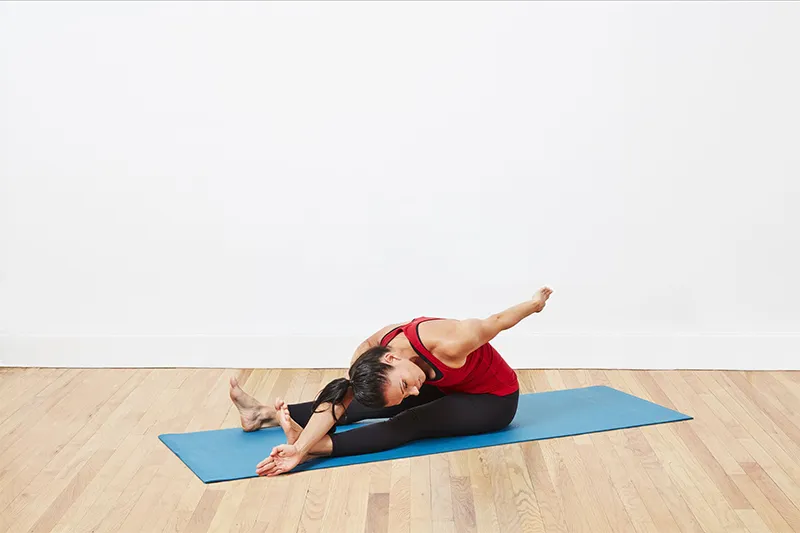
Variations of The Saw exercise.
2. Change the Rotation Angle
- Deeper rotation: Increase the range of rotation to maximize stretching of the abdominal and back muscles.
- Slower rotation: Perform the movement slowly and with control to better feel muscle engagement and lengthening.
3. Modify Arm Position
- Hands behind the head: Place the hands behind the head instead of reaching forward to increase abdominal engagement.
- Hands on shoulders: Place the hands on the shoulders and rotate to enhance shoulder and neck stability.
4. Combine With Other Movements
- Combine with plank: After completing The Saw, transition into a plank to build full-body strength.
- Combine with hip rotation: Add hip rotation together with trunk rotation to further improve spinal mobility.
Notes:
- Customize the exercise: Choose variations that suit your fitness level and physical condition.
- Listen to your body: Stop and rest if you feel pain or discomfort.
- Breathe steadily: Maintain smooth, even breathing throughout the practice.
The Pilates The Saw exercise not only improves flexibility but also enhances strength and balance throughout the body. Practicing this exercise correctly and consistently can deliver significant health benefits. Start incorporating The Saw into your Pilates routine today to experience positive changes.