

Pilates Side to Side Exercise Guide on Popular Equipment
02/02/2026The Pilates Side to Side exercise offers a clear insight into your body’s mobility and balance. From sitting upright to the gentle side to side motion, this exercise combines precision with flexibility. Learn how to perform this engaging exercise on Ladder Barrel, Spine Corrector, and Reformer in this detailed guide!
What is the Pilates Side to Side Exercise?
The Pilates Side to Side exercise is a movement aimed at increasing flexibility and strengthening the waist, hips, and intercostal muscles. This side leaning motion stretches and strengthens the muscles on both sides of the torso, helping to improve posture and reduce belly fat.
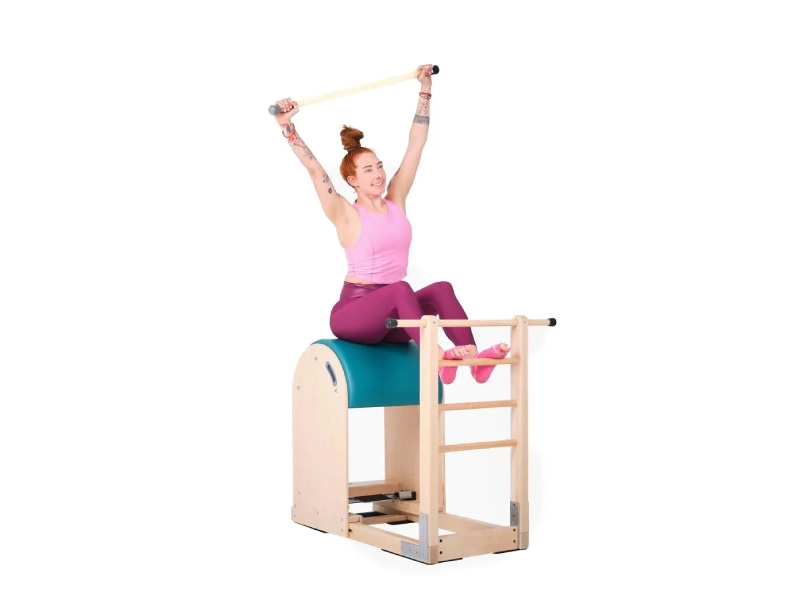
Pilates Side to Side exercise on Ladder Barrel.
Typically, the Pilates Side to Side exercise is performed on specialized Pilates equipment such as the Ladder Barrel, Spine Corrector, and Reformer. This exercise requires a combination of body control, balance, and precision, helping practitioners improve stability and coordination between the upper and lower body. Correct technique and attention to detail are essential, allowing individuals to enhance their body awareness.
Why Should You Add Side to Side to Your Workout Routine?
Among posture enhancing and core strengthening exercises, the Pilates Side to Side stands out as a simple yet highly effective movement, especially for those looking to regain overall body balance and support a healthier spine. The main benefits of this exercise include:
Rebalancing the Body
In daily life, most of us move in forward backward motions (walking, standing, sitting, bending), with little movement side to side. Pilates Side to Side helps rebalance body movements, reducing the risk of muscle imbalances, pelvic misalignment, and ensuring both sides of the body function evenly.
Activating the Core System
Although it seems simple, this exercise targets key muscles like the obliques, deep abdominal muscles, spinal extensors, and the pelvic region, areas crucial for maintaining posture and preventing back pain. Whether you’re doing Pilates for a toned physique or simply for overall health, a stable core is essential.
Improving Body Control and Awareness
Pilates isn’t about sweating through high intensity workouts or lifting heavy weights. Instead, it focuses on controlled movements, precise breathing, and tuning into your body’s inner signals. The Side to Side exercise exemplifies this approach: slow, deliberate, yet deep and effective.
Pilates Side to Side Exercise on Ladder Barrel
The Pilates Side to Side exercise can be performed on the Ladder Barrel, thanks to its curved structure and supportive steps. This setup allows for more accurate, safer, and better controlled movements than performing the exercise on a mat.
How to Perform the Pilates Side to Side on Ladder Barrel
1. Initial Setup
- Sit upright at the highest point (apex) of the Ladder Barrel.
- Stretch your legs straight ahead, keeping your body stable.
- Hold a wide wooden bar (pole) with both hands, reaching it overhead, keeping your arms straight without locking the elbows.
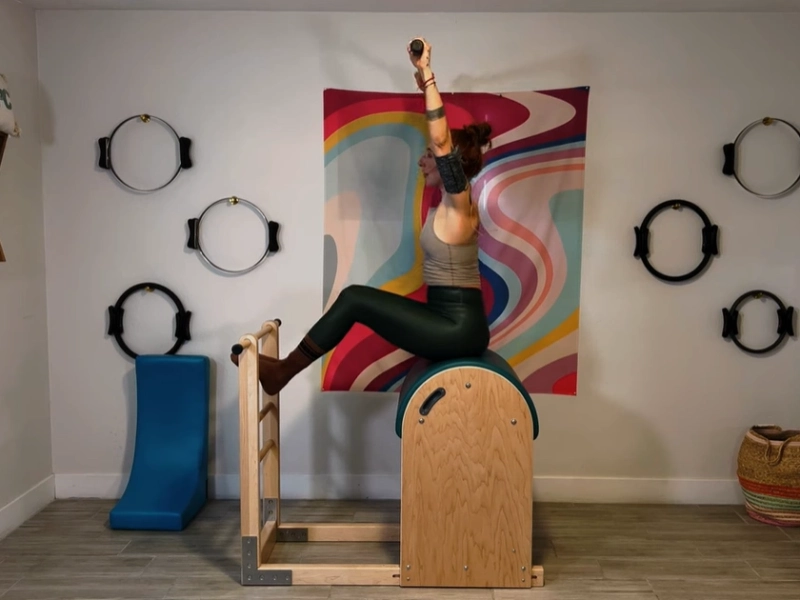
Perform the Pilates Side to Side on Ladder Barrel.
2. Perform the Side to Side Movement
- Keep your back straight and lift your body upwards.
- Slowly lean to one side, following a “long bend” motion, without shifting your center of gravity or rotating your ribcage.
- Return to the upright position and then lean to the other side.
- Repeat 2-3 times per side.
Transition Exercise: After completing the Side to Side exercise, continue with the Twist & Reach exercise to extend the movement sequence and optimize training results.
Pilates Side to Side on Spine Corrector
When performing the Side to Side exercise on the Spine Corrector, the practitioner sits on the equipment to support balance and enhance muscle stretching.
How to Perform Pilates Side to Side on Spine Corrector
1. Initial Position
- Sit beside the Spine Corrector, with your hip close to the edge of the equipment.
- Extend your lower leg (leg closest to the equipment) and bend the upper leg so the foot rests on the surface.
- Lean your torso onto the Spine Corrector, ensuring your spine is naturally curved.
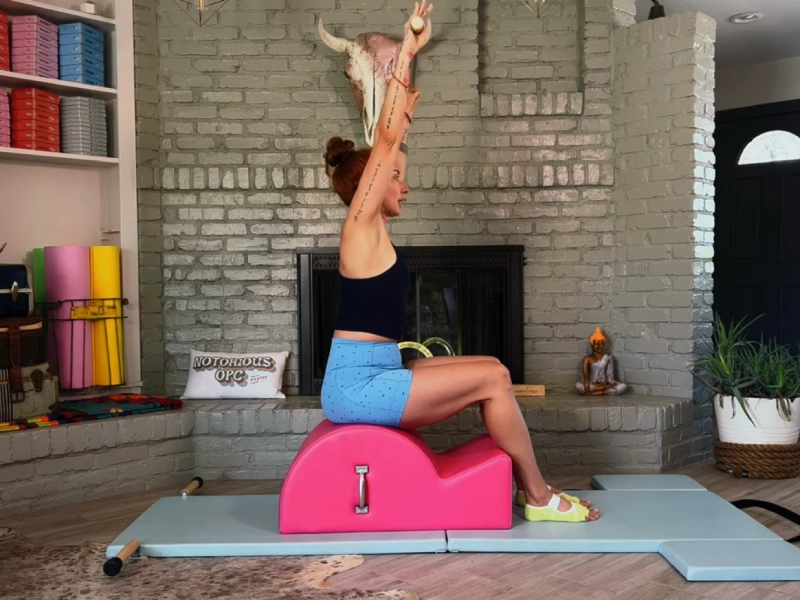
Perform Pilates Side to Side exercise on Spine Corrector.
2. Movement
- Place the lower hand behind your head or extend it, while the upper hand can be either extended or placed on your hip.
- Inhale deeply, then gently bend your torso towards the upper hand, lengthening the ribcage and spine.
- Exhale and return to the starting position, maintaining control with each movement.
- Repeat 5-10 times before switching sides.
Pilates Side to Side on Reformer
Performing the Side to Side exercise on the Reformer enhances its effectiveness due to the resistance from the springs, the carriage, and the shoulder supports. This setup provides better control over resistance and movement amplitude, improving flexibility, posture, and balance, while reducing muscle imbalances and promoting spinal mobility.
How to Perform Pilates Side to Side on Reformer
1. Initial Setup
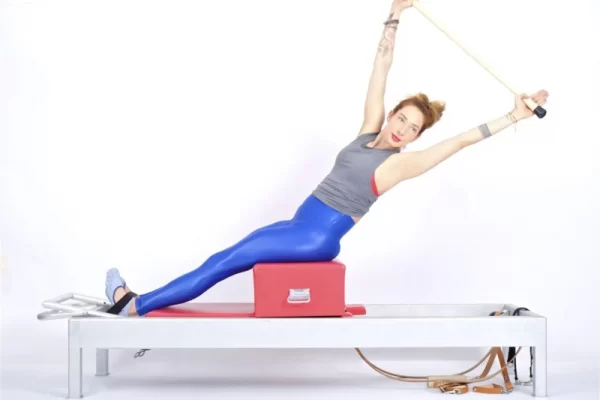
Sit upright with your legs wide apart, securing them in the straps and pushing them outward. Keep your torso tall and stable. Hold the wooden bar with both hands and lift it to shoulder height.
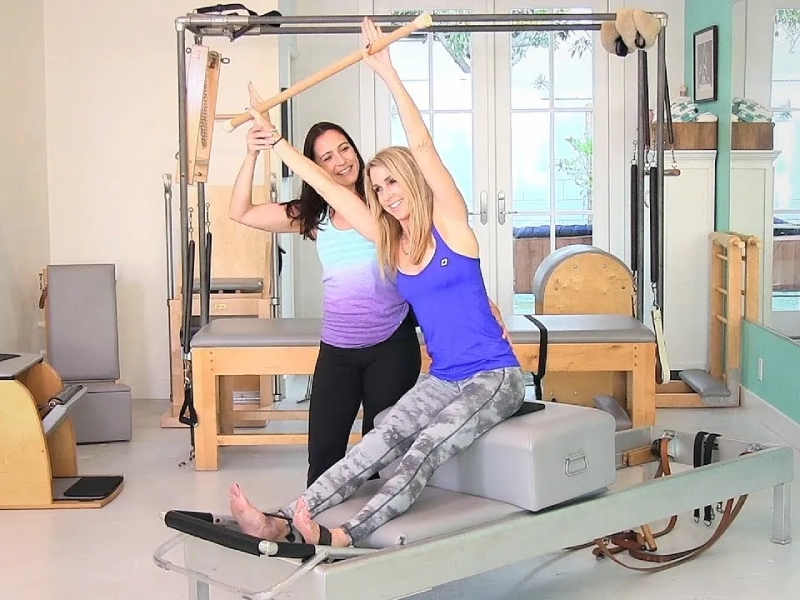
Perform Pilates Side to Side exercise on Reformer.
2. Performing the Movement
- From the seated position, first lift your torso upwards, then lean to the right side. Ensure the movement isn’t a quick bending motion but a controlled stretch.
- Keep your spine lengthened, with your head and arms maintaining the same distance.
- Engage your abdominal and back muscles to return to the upright position.
- Repeat the movement on the left side.
- Perform 3-5 repetitions per side, or 2-3 sets if training in groups.
Key Points to Keep in Mind When Practicing Side to Side
To maximize the effectiveness and safety of the Pilates Side to Side exercise, focus on the following key factors:
- Inhale while bending your torso, and exhale when returning to the starting position. This helps relax your body and maintain control.
- Ensure your body stays aligned throughout the movement, avoiding excessive twisting.
- This focuses the effort on the intercostals and abdominal muscles without stressing the spine.
- Avoid relying too much on your legs or arms during the movement. Focus on using your core and hips to control the motion.
- Keep your shoulders relaxed and open, avoiding tension near the ears or letting the shoulders sag too low, which could strain your neck.
- Perform the movement slowly and with control, avoiding rushing or losing balance.
Through this guide, you should now have a clear understanding of how to perform the Pilates Side to Side exercise on various Pilates equipment. Pay attention to every detail for optimal results in your practice. With consistency and correct technique, this exercise will enhance your strength, flexibility, and body awareness, boosting your confidence in every movement.