

Pilates Side Kick Kneeling Exercise Overview: Technique, Benefits, and Proper Practice
02/01/2026You may have heard of the Pilates Side Kick Kneeling exercise, but have you ever truly felt the subtlety and power hidden within each movement? This is not just a simple exercise it is a journey that deeply activates the hips and thighs, helping your body become not only stronger but also fluid and graceful. With its ability to awaken inner balance and improve flexibility, this exercise resembles a “still dance” between strength and elegance. Let’s explore how to perform the Pilates Side Kick Kneeling exercise and why it deserves a place in your body care journey.
What Is the Pilates Side Kick Kneeling Exercise?
Side Kick Kneeling is one of the 34 original Pilates exercises. It is a highly challenging full body movement that strengthens the entire back, opens the chest, and enhances shoulder stability. At the same time, it strengthens and stretches the iliopsoas muscles (hip flexors) and the quadriceps (the four muscles at the front of the thigh).

Side Kick Kneeling is a very difficult full body exercise.
Side Kick Kneeling offers many of the same benefits as the Side Kick, but it significantly increases the stability challenge because you are supported by only one knee and one straight arm. It also intensifies activation of the lateral spinal flexors on the side closest to the mat especially the intercostal muscles to maintain the side bending position of the torso. Finally, it provides essential practice in using the shoulder adductors and scapular stabilizers on the supporting arm, a skill that becomes even more demanding in exercises such as Side Bend and Twist.
How to Perform the Side Kick Kneeling Pose
Steps to perform the Pilates Side Kick Kneeling exercise
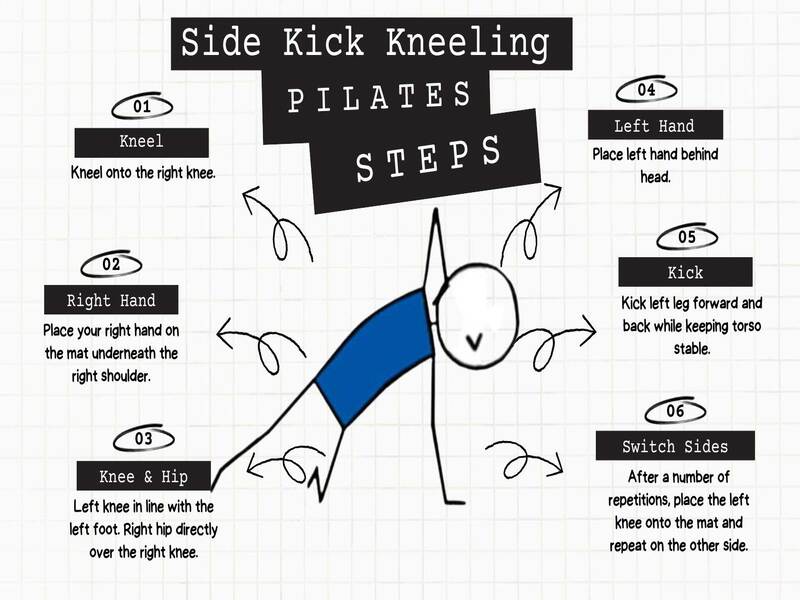
Below are the steps to perform the Pilates Side Kick Kneeling exercise:
- Begin in a tall kneeling position. Place your knees hip width apart. Lengthen your spine and neck. Let your arms rest long by your sides.
- Inhale to prepare.
- Exhale and shift your body weight onto your right hand and knee, keeping the spine straight.
- At the same time, lift the left leg out to the side at hip height, aligning it with your torso.
- Aim to keep the head, torso, thigh, and lower leg in one horizontal line.
- Place the top hand behind your head or on your hip.
- Inhale and hold the side kick position.
- Exhale, sliding the top leg forward from the hip joint while maintaining the side bent posture.
- Inhale and slide the top leg backward until it aligns with the torso.
- Repeat 3-4 slow kicks while maintaining the kneeling side kick position.
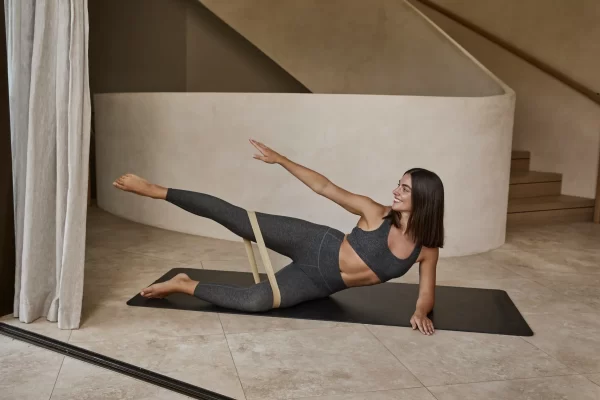
How to perform the Side Kick Kneeling pose.
Target Muscles
Primary muscles
- Lateral spinal flexors and stabilizers: external obliques, internal obliques, quadratus lumborum,
- erector spinae (spinalis, longissimus, iliocostalis), semispinalis, deep posterior spinal muscles, rectus abdominis, transversus abdominis
- Hip abductors: gluteus medius, gluteus minimus, tensor fasciae latae, sartorius
Supporting muscles
- Hip flexors: iliacus, rectus femoris
- Hip extensors: gluteus maximus, hamstrings
- Knee extensors: quadriceps
- Plantar flexors and ankle stabilizers: gastrocnemius, soleus
- Shoulder adductors: middle deltoid, supraspinatus
- Scapular depressors: lower trapezius, serratus anterior (lower fibers)
- Scapular stabilizers: serratus anterior
- Elbow extensors: triceps brachii
Tips for Performing the Side Kick Kneeling Pose
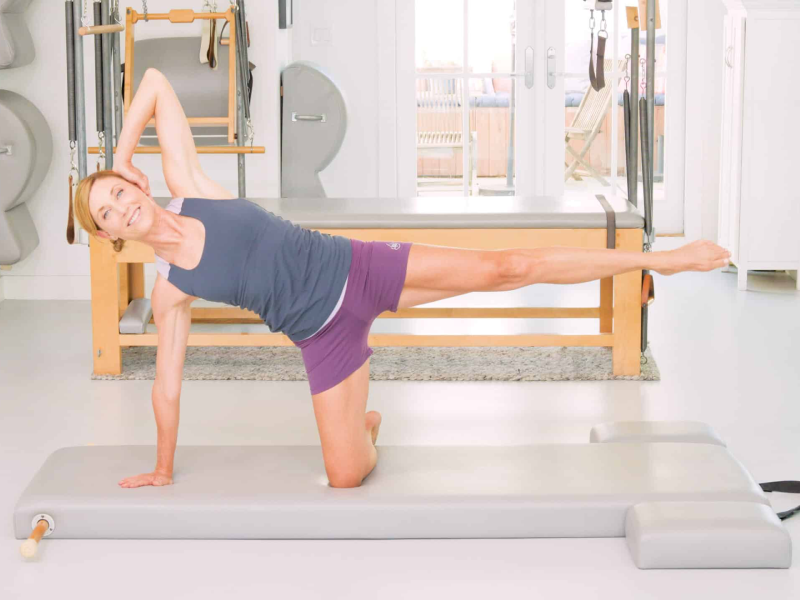
Throughout the Pilates Side Kick Kneeling exercise, imagine your body forming a graceful arc from head to the supporting knee. Press into the mat with your hand and use the shoulder adductors to lift the upper body, the lateral spinal flexors on the mat side of the body to elevate the spine, and the hip adductors to lift the lower pelvis working together to create this arc.
As you press into the mat, engage the elbow extensors to keep the arm straight, while drawing the shoulder blade downward and toward the mat using the scapular depressors and stabilizers, particularly the serratus anterior.
Tips for performing the Side Kick Kneeling pose.
Keep the lifted leg long as it swings, using the knee extensors to straighten the knee and the plantar flexors to point the foot forward.
Focus on maintaining the appropriate height of the lifted leg by engaging the hip abductors of the top leg, while the hip flexors guide the leg forward and the hip extensors guide it slightly backward.
Visualize your body as a curved bridge, with the arm acting as a vertical support while the leg swings freely forward and back without disrupting the strong structure of the bridge.
Modifications and Variations of the Side Kick Kneeling Exercise
Modifications
One of the most challenging aspects of the Pilates Side Kick Kneeling exercise is maintaining a consistent height of the moving leg. The leg tends to drop when transitioning from front to back and vice versa. To practice maintaining consistent height, choose a less demanding level even if it is below the top hip joint. Then move the leg as described in steps 2 and 3, keeping the same distance from the mat as if the leg were sliding across a tabletop.
Variations
Perform the exercise with the supporting knee positioned almost directly under the hip joint and keep the swinging leg as high as possible to further challenge the hip abductors. You may also incorporate double leg pulses, foot placement, and percussive breathing patterns as described in the Side Kick variations.
Using the position described in the Side Kick Kneeling variations, extend the fingers of the top arm toward the ceiling instead of placing the hand behind the head. This position not only enhances visual appeal but also further challenges body stability, helps maintain an open chest position, and increases shoulder engagement to keep the arm lifted and stable.
The Pilates Side Kick Kneeling exercise not only improves strength and flexibility but also offers moments of relaxation and stress relief after a long day. Consistent and dedicated practice will bring remarkable results. Don’t hesitate to begin today and experience the difference this exercise can make for both your body and mind.