

Pilates Hundred Exercise: How to Perform, Benefits, and Common Mistakes to Avoid
25/12/2025The Hundred exercise is one of the foundational movements in Pilates, well known for activating the abdominal muscles while improving flexibility and overall body strength. Whether you are a beginner or an experienced practitioner, understanding correct technique, key benefits, and common mistakes is essential. This article provides a detailed guide to the Pilates Hundred exercise, its health benefits, and important precautions to help you train safely and effectively.
What Is the Pilates Hundred Exercise?
The Pilates Hundred is one of the 34 original Pilates exercises described by Joseph Pilates in his 1945 book Return to Life Through Contrology.
This exercise involves pumping the arms five times while inhaling and five times while exhaling, maintaining abdominal engagement, extended legs, and arms reaching long by the sides with palms facing down.
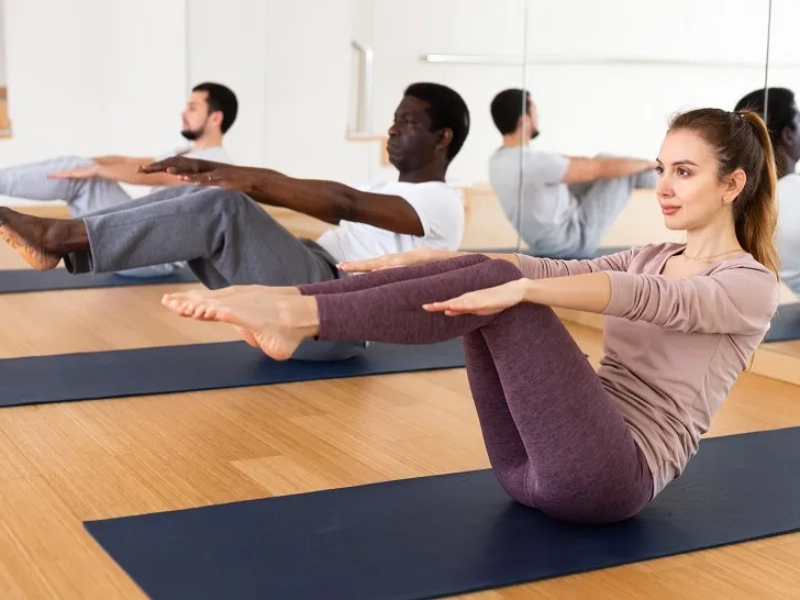
Pilates Hundred is one of the 34 original Pilates exercises.
The Pilates Hundred is commonly used as a warm up exercise to stimulate circulation and prepare the body for a full workout. It also establishes proper breathing patterns and helps practitioners connect movement with breath. Despite its intimidating name, “Hundred” refers to the total number of arm pumps performed, not repetitions of the exercise itself.
Benefits of the Pilates Hundred Exercise
The Pilates Hundred has remained a staple of Pilates practice due to its proven, long term benefits. From strengthening the core to improving circulation, this exercise delivers multiple advantages:
1. Strengthens the Abdominal Muscles
The Hundred is best known for its powerful effect on the core muscles. It activates the entire abdominal wall, strengthening the transverse abdominis and intercostal muscles.
This exercise also enhances the ability of the trunk muscles to maintain proper spinal and pelvic alignment during movement. As a result, it improves balance, supports the spine, enhances daily functional movement, and helps reduce injury risk.
2. Engages the Whole Body
Beyond core activation, the Pilates Hundred engages the arms and shoulders through continuous arm pumping. The inner thighs, glutes, and hip flexors are also activated, making this a true full body exercise.
3. Improves Blood Circulation
The Hundred quickly elevates the heart rate and promotes better blood circulation. It is especially effective as a warm up before mat work or higher intensity equipment based Pilates exercises.
4. Enhances Breathing Efficiency
The distinctive breathing pattern used in the Pilates Hundred increases oxygen intake, regulates breathing rhythm, and may improve lung capacity and respiratory function over time.
How to Perform the Pilates Hundred Exercise
Although the Pilates Hundred offers clear benefits, incorrect execution may cause tension in the neck and shoulders. This exercise can be performed on a mat or on Pilates equipment. Below is the standard mat version.
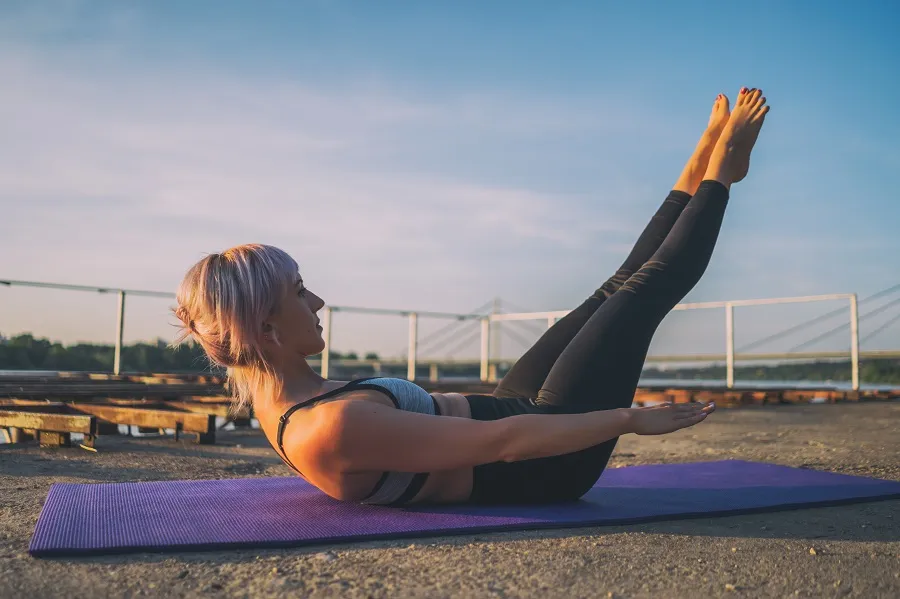
How to perform the Pilates Hundred exercise on the mat.
Step by Step Guide to the Pilates Hundred on the Mat
- Lie on your back on the mat, body fully extended. Keep the lower back pressed firmly into the mat without arching.
- Bend the knees, placing the feet flat on the mat to prepare.
- Lift the head, neck, and shoulders slightly off the mat. Gently tuck the chin toward the chest without straining the neck.
- Extend the arms long by the sides, palms facing down.
- Draw the abdominal muscles inward to support the lower back.
- Extend both legs upward to about a 45 degree angle. If the lower back lifts off the mat, lower the legs until proper alignment is restored.
- Begin pumping the arms up and down: inhale for five arm pumps, then exhale for five arm pumps. Breathe in through the nose and out through the mouth. Keep the neck and shoulders relaxed so the abdominals remain the primary working muscles.
- Repeat for 10 breathing cycles, totaling 100 arm pumps.
Performing the Pilates Hundred on Equipment
Pilates Hundred with the Magic Circle
The Magic Circle is a compact Pilates prop designed to provide gentle resistance and enhance muscle activation. Performing the Pilates Hundred with the Magic Circle emphasizes breath control, arm rhythm, and lower body stability while improving core engagement.
How to perform:
Preparation:
- Lie on your back with the Magic Circle placed between the ankles.
- Arms rest long by the sides, palms down.
Starting position:
- Lift the head and neck, gaze toward the legs.
- Extend the legs to a 45-degree angle.
Execution:
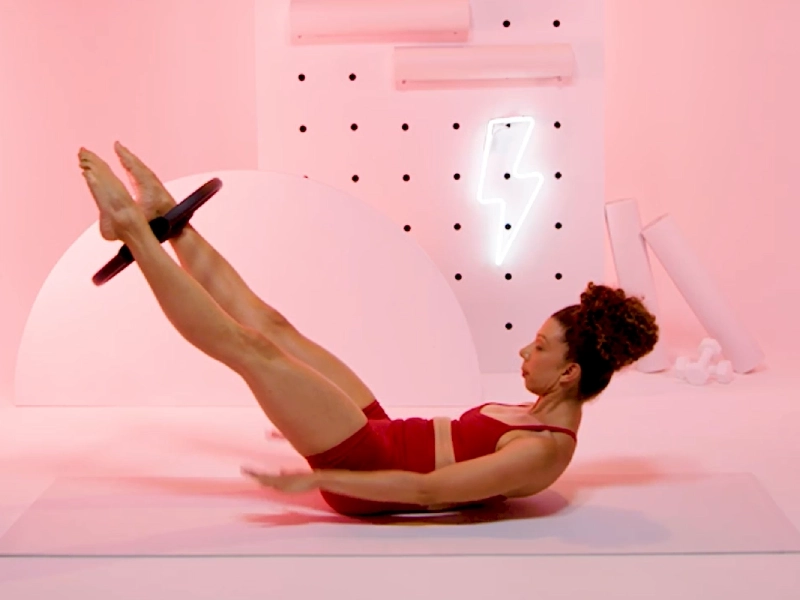
Perform the Pilates Hundred exercise with the Magic Circle hoop.
- Gently squeeze the Magic Circle by engaging the inner thighs.
- Begin small, controlled arm pumps alongside the body.
Breathing:
- Inhale for 5 arm counts.
- Exhale for the next 5 arm counts.
Completion: Continue until reaching 100 arm pumps.
Modifications:
- Bend the knees into a tabletop position if needed.
- Place the Magic Circle between the inner thighs instead of the ankles to reduce intensity.
Note: Maintain strong core engagement and a neutral spine throughout the exercise.
Pilates Hundred on the Spine Corrector
The Spine Corrector is designed to support the back, hips, and shoulders while improving spinal mobility. When combined with the Pilates Hundred, it enhances control and provides additional lumbar support, making it ideal for beginners or those refining core precision.
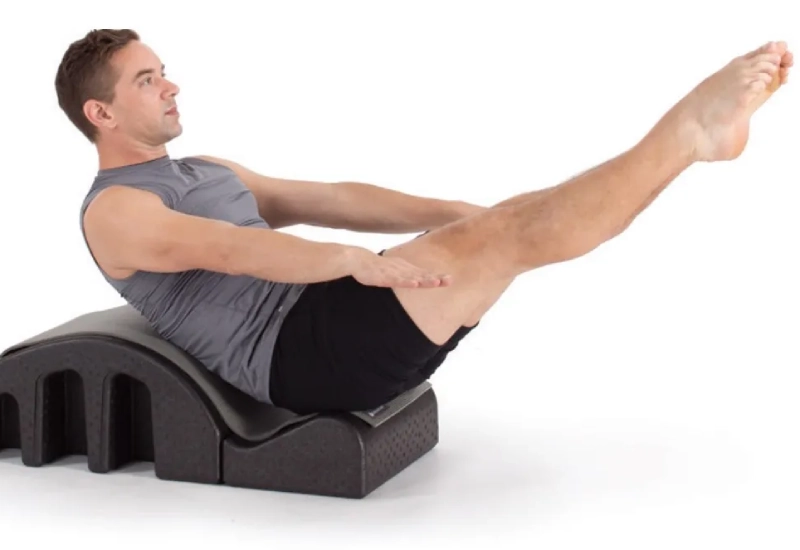
Pilates Hundred exercise on the Spine Corrector.
How to perform:
- Sit upright on the Spine Corrector with knees bent and feet on the floor.
- Lean back so the lower back is supported by the curve of the Spine Corrector.
- Lift the legs so the thighs are parallel to the floor, knees slightly bent.
- Inhale and lift the head and shoulders, maintaining spinal support.
- Perform the Hundred breathing pattern: inhale for 5 counts, exhale for 5 counts, until completing 100 arm pumps.
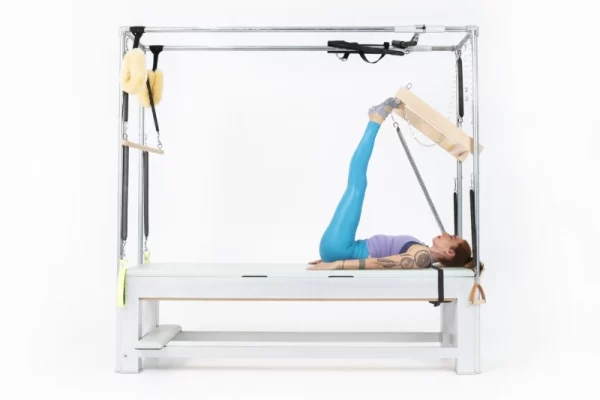
Pilates Hundred on the Wunda Chair
Performing the Pilates Hundred on the Wunda Chair increases the challenge and demands greater body control.
How to perform:
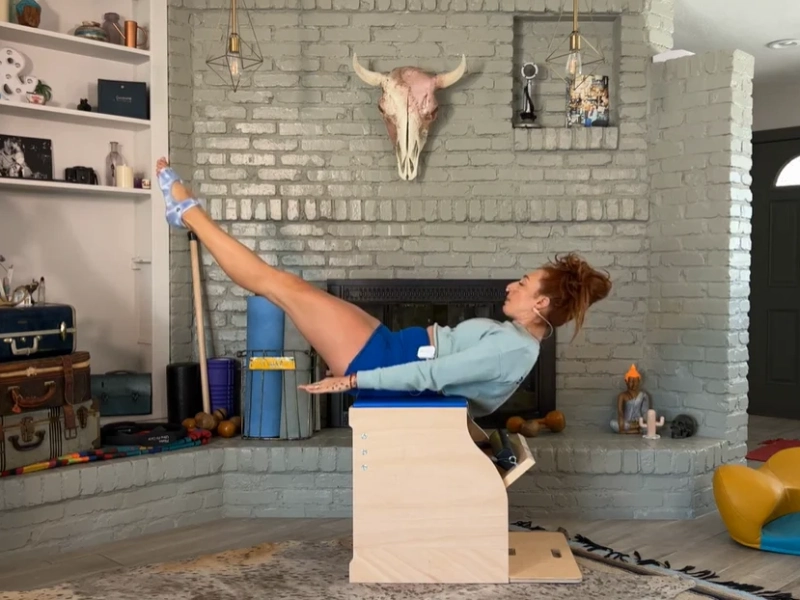
Pilates Hundred exercise on the Wunda Chair.
- Lie lengthwise on the chair (easier) or across the top (more advanced).
- Begin with the head and chest slightly curled up, knees bent toward the chest.
- Extend the legs diagonally while maintaining pelvic stability.
- Pump the arms rhythmically: inhale for 5 counts, exhale for 5 counts.
- Complete 10 breathing cycles (100 arm pumps).
- Finish by drawing the knees in and resting.
Pilates Hundred on the Ladder Barrel
This advanced variation strengthens deep core muscles and enhances breath movement coordination. The curved surface supports spinal alignment while challenging balance and control.
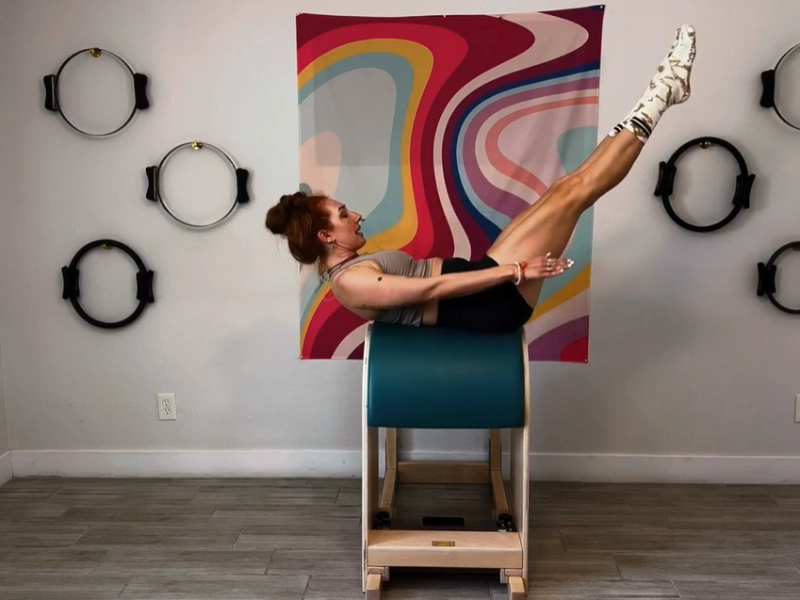
Pilates Hundred exercise on the Ladder Barrel.
How to perform:
- Sit at the top of the Ladder Barrel and roll back until the spine rests evenly along the curve.
- Draw knees toward the chest and lift the head and chest.
- Extend the legs forward, slightly higher than mat level.
- Pump the arms while maintaining the Pilates Hundred breathing pattern.
- Complete 100 arm pumps, then return to rest.
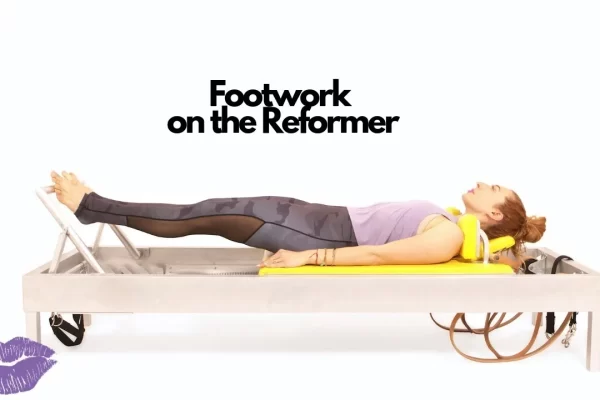
Pilates Hundred on the Reformer
The Reformer allows adjustable resistance through springs, making the Pilates Hundred adaptable to different strength levels.
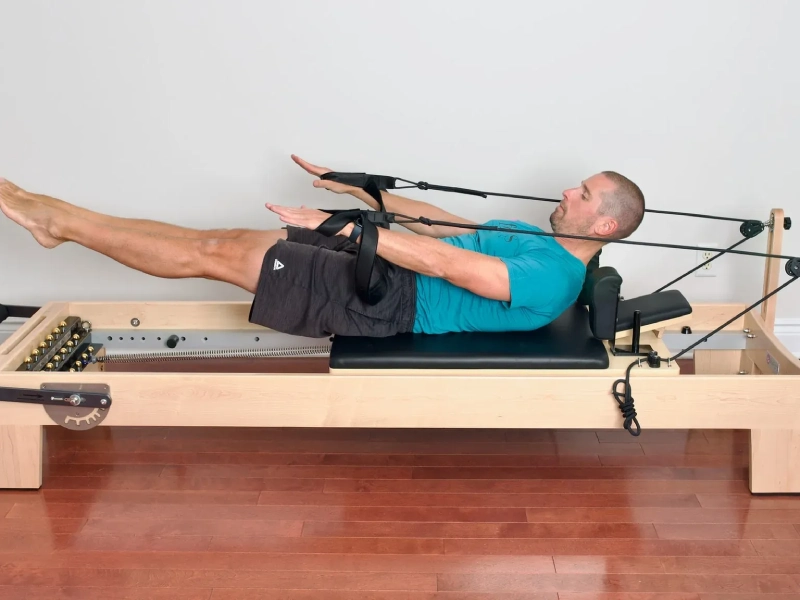
Pilates Hundred exercise on the Reformer.
How to perform:
- Set 3-4 springs based on your ability.
- Lie on your back, heels on the footbar.
- Lift one or both legs, raise the head and chest.
- Pump the arms: inhale 5 counts, exhale 5 counts.
- Maintain control, then return to the starting position.
Variations and Modifications of the Pilates Hundred Exercise
The Pilates Hundred is suitable for most fitness levels but should be modified as needed. Pregnant individuals should avoid this exercise after the first trimester or when the abdomen begins to expand. Those with pelvic floor issues should also skip this movement.
Beginner Modifications
- Raise the legs higher (up to 90 degrees) to reduce lower back strain.
- Keep the feet on the mat or lie fully flat initially.
- Lift the head and legs gradually as strength improves.
Advanced Modifications
Hold a Pilates ring or ball between the legs to increase core activation and intensity.
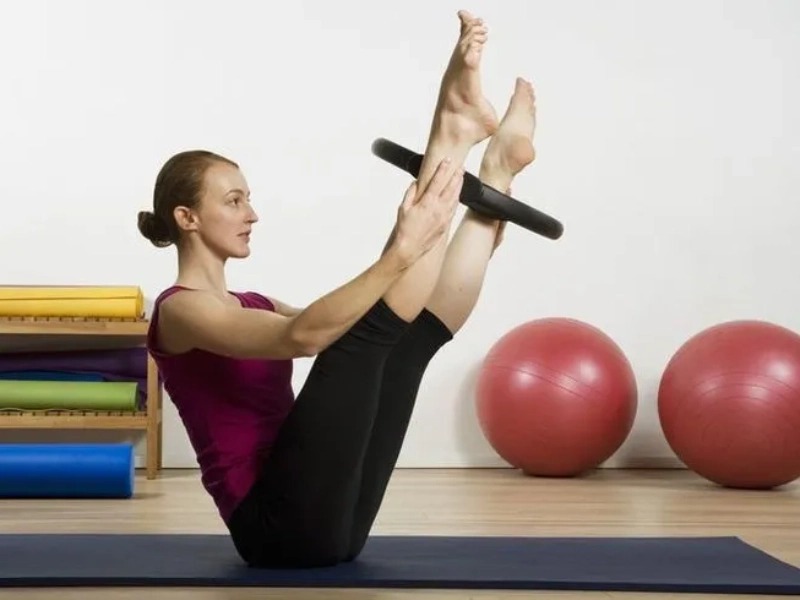
Some variations and modifications of Pilates Hundreds.
Modifications for Injury Support
- Place a block under the head or support the head with one hand if neck discomfort occurs.
- Keep the head down and knees bent to reduce strain.
- Focus on controlled breathing and gentle arm pumps.
Common Mistakes to Avoid When Performing the Pilates Hundred
- Lifting from the neck: Engage the core to lift the shoulders, not the neck.
- Chin lifted too high: Keep the chin slightly tucked, maintaining space between chin and chest.
- Arching the lower back: Maintain a neutral pelvis throughout the exercise.
- Bending the wrists: Movement should originate from the shoulders, not the wrists.
- Legs positioned too high or too low: Aim for a 45-degree angle unless modifying intentionally.
- Holding the breath: Consistent breathing is essential for effectiveness.
The Pilates Hundred exercise is a cornerstone of any Pilates routine, offering significant benefits for core strength, breathing efficiency, and overall conditioning. With proper technique, appropriate modifications, and awareness of common mistakes, you can safely integrate the Pilates Hundred into your training and maximize its benefits for your body.