

Pilates Double Leg Stretch Exercise: Step by Step Guide, Benefits, and Variations
25/12/2025In the classical Pilates sequence, the Double Leg Stretch is considered one of the most effective exercises for building strong core muscles and improving coordinated breathing. If you want to practice according to the original Pilates method, this is an exercise you should not skip. Let’s explore the detailed guide to the Pilates Double Leg Stretch exercise below.
What Is the Pilates Double Leg Stretch Exercise?
The Pilates Double Leg Stretch is one of the 34 foundational exercises in the classical Pilates system. This exercise primarily focuses on strengthening the abdominal muscles while improving overall body control and coordination in a smooth, efficient way.
What makes this exercise special is that the torso remains stable and still, without rocking or shifting, while the arms and legs extend and draw in simultaneously. As a result, the abdominal muscles are fully engaged and activated, supporting spinal stability and helping to build a stronger, healthier back.
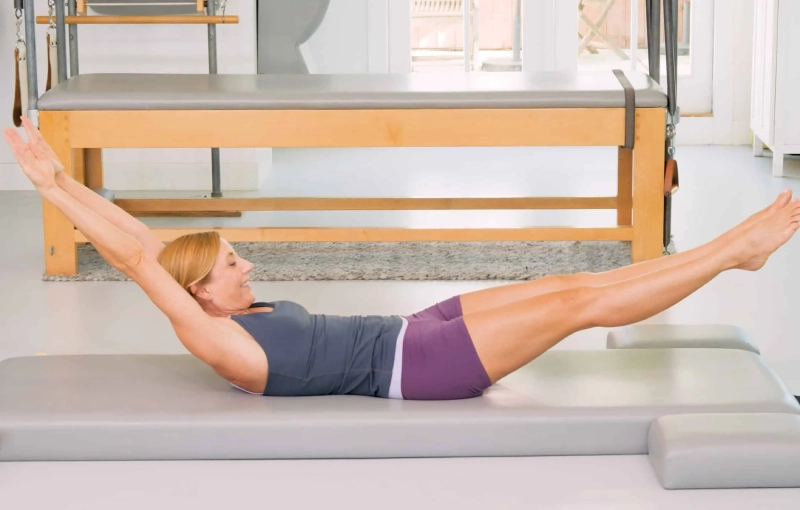
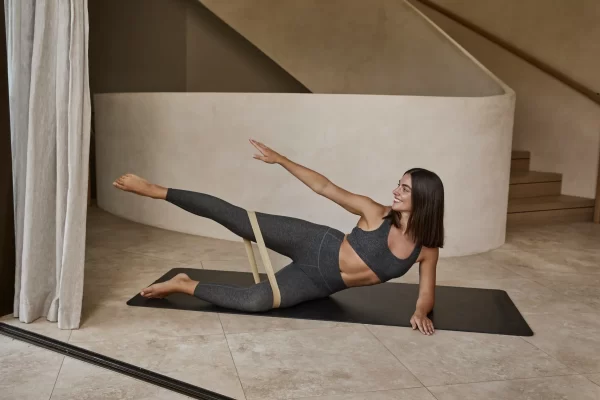
Pilates Double Leg Stretch pose.
Although it may sound simple, the Double Leg Stretch is relatively challenging, especially for beginners. Lifting and holding both legs off the mat at the same time requires strong and flexible abdominal muscles, back muscles, and hips. However, this challenge brings significant benefits: it not only tones the body but also trains focus and mental discipline qualities often lacking in today’s distraction filled modern life.
Therefore, if you are looking for an exercise that helps improve both physical shape and mental clarity, the Pilates Double Leg Stretch exercise is definitely worth trying.
Benefits of the Double Leg Stretch Exercise
Although simple in appearance, the Pilates Double Leg Stretch offers numerous benefits for your health and physique. Below are some key advantages:
- Improves core strength: This exercise directly targets the core muscles, including the abdominals and lower back, helping to build strength and stability in the center of the body.
- Enhances hip and leg flexibility: The leg lifts and knee bending movements increase flexibility in the hip joints, knees, and surrounding muscles.
- Improves posture: By focusing on keeping the lower back pressed into the mat and increasing body awareness, this exercise helps improve posture and reduce back and neck discomfort.
- Reduces stress and promotes relaxation: Controlled movements combined with deep breathing help relieve tension, reduce fatigue, and enhance relaxation.
- Enhances coordination between arms and legs: Moving the arms and legs in opposite directions improves coordination and overall body control.
- Supports digestion: Gentle abdominal compression stimulates the digestive system and supports better digestive function.
- Improves blood circulation: Consistent movements enhance circulation, delivering oxygen and nutrients to the muscles.
- Builds muscular endurance: Repeating the movement helps increase muscle endurance over time.
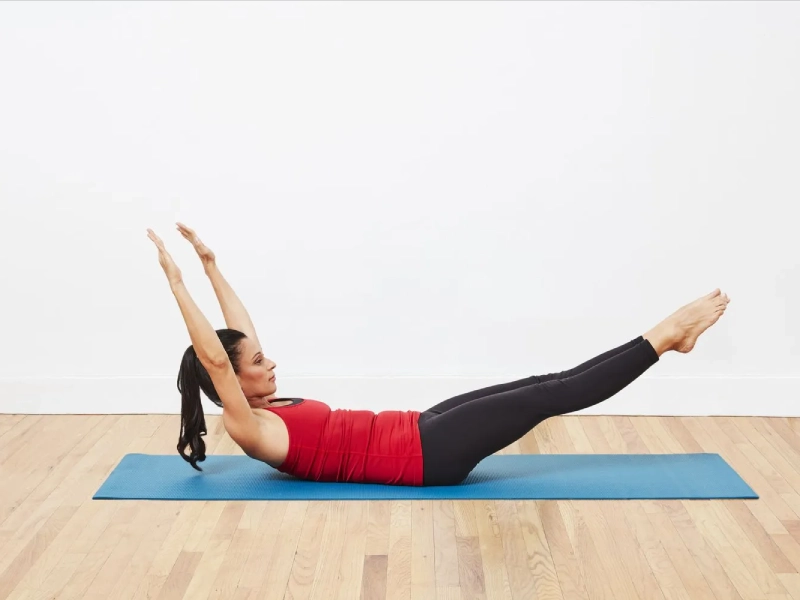
Benefits of the Double Leg Stretch exercise.
Step by Step Guide to Performing the Double Leg Stretch
Execution Steps:
- Lie on your back with both hands placed behind your head, one hand resting on the other (do not interlace the fingers). Keep the elbows wide.
- Extend both legs straight up toward the ceiling, heels together and toes slightly turned outward. Engage the inner thighs and draw the navel toward the spine.
- Inhale and lower the straight legs toward the mat for three counts. Stop if you feel the lower back starting to arch.
- Exhale as you lift the legs back up toward the ceiling. Do not let the legs go past 90 degrees; keep the tailbone anchored to the mat.
- Repeat 8-10 times. Finish by drawing both knees into the chest.
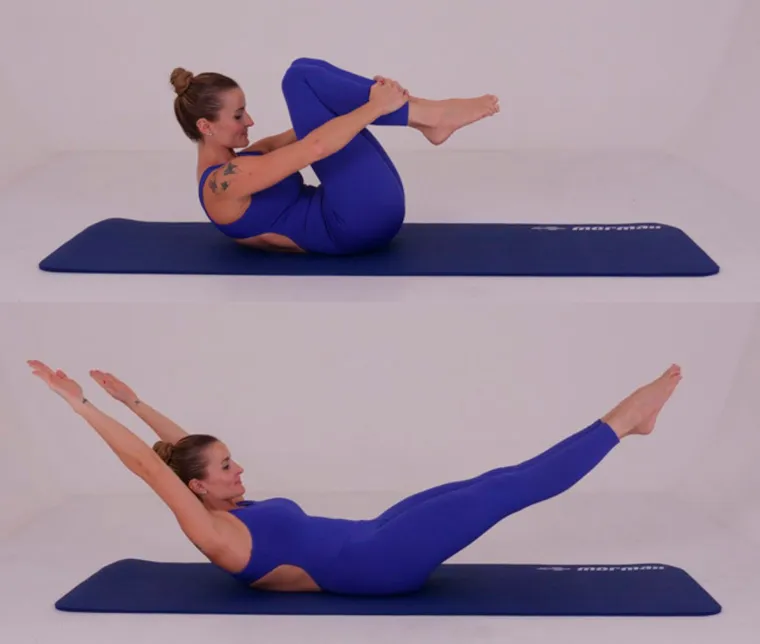
Steps to perform the Double Leg Stretch.
Tips for Practicing the Pilates Double Leg Stretch exercise:
- Always keep the abdominal muscles fully engaged; do not allow them to bulge.
- Keep the lower back and pelvis completely stable as the legs lower. Maintain contact between the lower ribs and the mat, and keep the tailbone heavy.
- Keep the elbows open and the upper back wide.
- Activate the shoulders by gently pressing the head into the hands and the hands into the head.
- Imagine wearing a belt and tightening it one notch more with each repetition.
Variations of the Pilates Double Leg Stretch exercise
The Double Leg Stretch is a foundational exercise, but with small adjustments, you can increase its effectiveness and challenge.
1. Beginner Variations
Lower the leg angle: Instead of lowering the legs to 45 degrees, start with a smaller angle such as 30 degrees to reduce pressure on the lower back.
Keep one leg grounded: Keep one foot on the mat while lifting the other leg to focus on stability and movement control.
2. Advanced Variations
Increase the speed: Once comfortable with the basic movement, increase the tempo to elevate heart rate and burn more calories.
Combine with other exercises: Pair the Double Leg Stretch with movements such as Roll Up or The Hundred to create a continuous Pilates sequence.
Add resistance: Hold a small ball or light weight to increase strength demands.
Lift the legs higher: When fully proficient, raise the legs higher than 45 degrees to intensify the exercise.
3. Variations Targeting Different Muscle Groups
Double Leg Stretch with torso rotation: Rotate the torso to the left or right as you lift the legs to activate the obliques.
Double Leg Stretch with toe touch: Reach the hands toward the toes when lifting the legs to enhance spinal mobility and abdominal engagement.
Notes:
- Listen to your body: Stop immediately if you feel pain or discomfort.
- Seek professional guidance: Beginners or those with health concerns should consult a specialist before attempting advanced variations.
Pilates Double Leg Stretch Using Equipment
In addition to mat practice and variations, the Double Leg Stretch can also be performed using popular Pilates equipment such as the Wunda Chair and the Magic Circle.
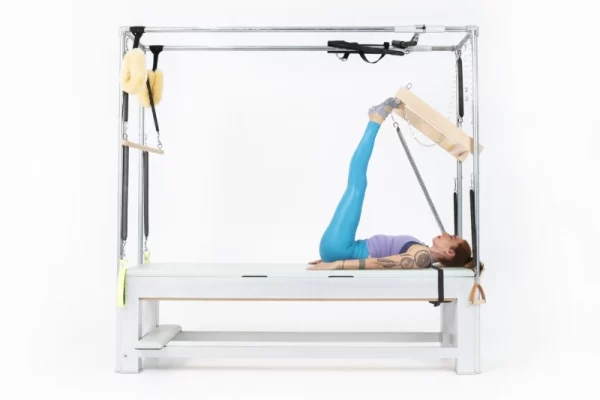
Pilates Double Leg Stretch on the Wunda Chair
In this variation, practitioners use the Wunda Chair to perform simultaneous leg extension and flexion while maintaining upper-body control and steady breathing. The Pilates Double Leg Stretch exercise on the Wunda Chair is commonly included in advanced Pilates programs and is suitable for those familiar with basic exercises who want to challenge balance, core strength, and overall flexibility.
How to Perform the Double Leg Stretch on the Wunda Chair:
Step 1: Preparation
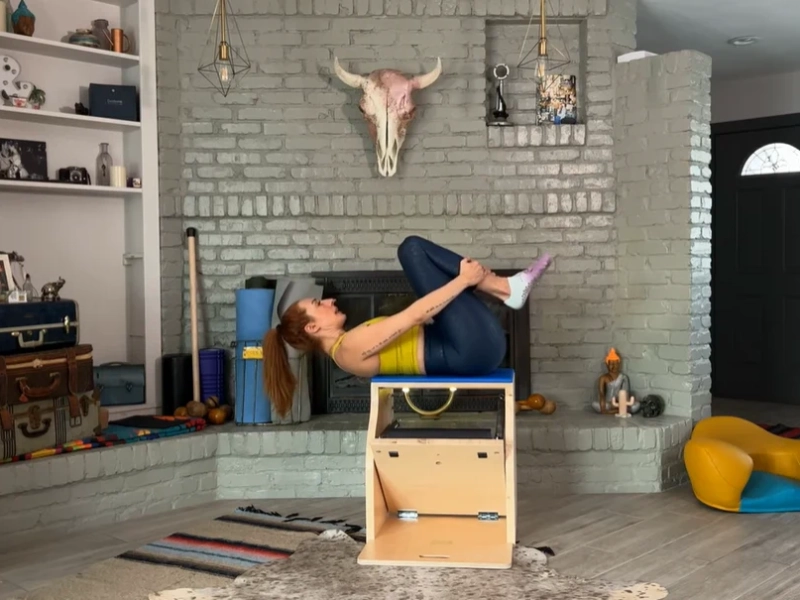
Preparation.
- If transitioning from the Single Leg Stretch, draw both knees into the chest.
- Place one hand on each ankle, keep the heels together, and allow the knees and toes to slightly open.
- If starting independently, lie on top of the Wunda Chair either lengthwise (easier) or crosswise (more challenging).
Step 2: Set the Position
- Draw the knees tightly into the chest, holding the ankles or shins.
- Keep the heels together with knees and toes gently open.
- Curl the head and lift the chest, keeping the neck long and relaxed.
Step 3: Extend Arms and Legs
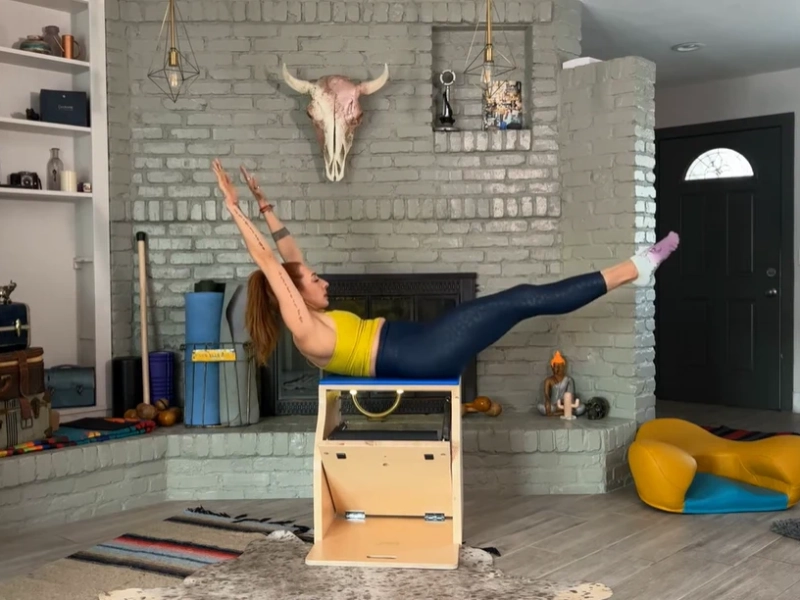
Straighten your arms and legs.
- From the curled position, stretch the arms overhead while extending the legs along a high diagonal line.
- Maintain core stability and avoid excessive arching of the back.
Step 4: Complete One Movement Cycle
Circle the arms around the body and pull the knees back into the chest. Gently draw the knees in once more to deepen the movement.
Step 5: Repeat and Finish
- Repeat for the desired number of repetitions.
- After finishing, transition into the Single Straight Leg Stretch or sit up to rest.
Note: Coordinate breathing smoothly inhale as you extend the arms and legs, exhale as you draw the knees back in.
Pilates Double Leg Stretch exercise with the Magic Circle
The Magic Circle (Pilates ring) is a lightweight, durable, and flexible prop designed to add resistance and increase exercise intensity. When used with the Double Leg Stretch, the Magic Circle optimizes the stretching motion and strongly activates the working muscles, especially the core (including the abdominals, lower back, and hips).
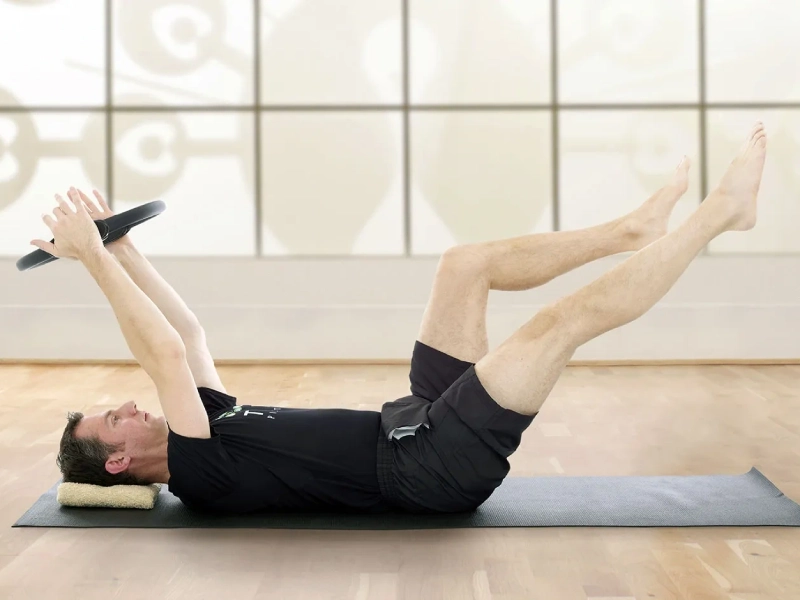
Double Leg Stretch exercise with Magic Circle hoop.
This variation is ideal for those looking to challenge themselves with a more advanced version of the traditional Double Leg Stretch. With the Magic Circle, practitioners can feel a stronger connection between body movements and deep core engagement.
How to Perform the Pilates Double Leg Stretch with the Magic Circle
1. Preparation
- Lie on your back on a Pilates mat, keeping the spine neutral and comfortable.
- Draw both knees toward the chest and hold the Magic Circle in front of the legs.
2. Magic Circle Placement
Place the Magic Circle between the ankles, ensuring it is secure and does not slip.
3. Starting Position
- Lift the head, neck, and shoulders off the mat, eyes focused toward the abdomen.
- Place the hands on the shins or ankles, preparing for movement.
4. Perform the Movement
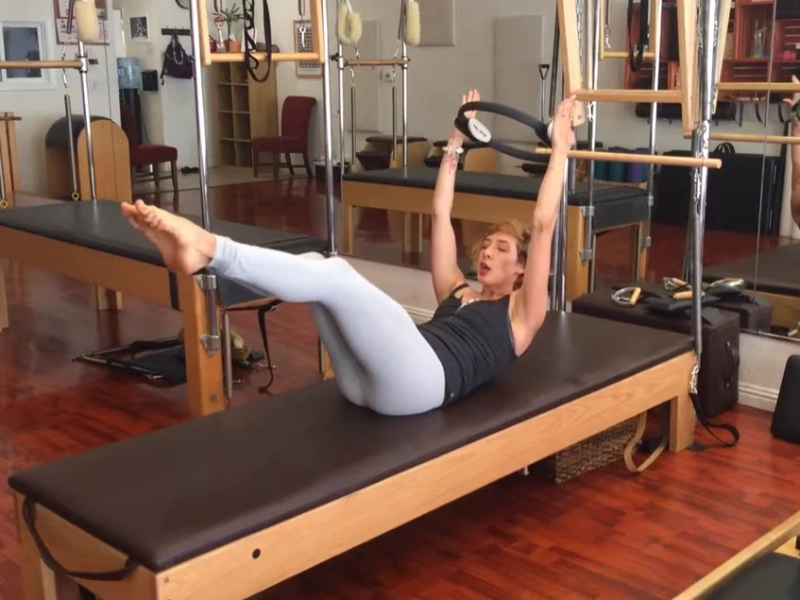
Inhale and extend both legs forward.
- Inhale: Extend both legs forward at approximately a 45-degree angle while reaching the arms overhead, forming a straight line from fingertips to toes.
- Exhale: Draw both knees back toward the chest while returning the arms to the starting position, holding the shins or ankles.
- Repeat 8-10 times, depending on your fitness level.
Notes:
- Keep the Magic Circle stable between the ankles throughout the movement.
- Control the breathing rhythm inhale to extend, exhale to draw in.
- Maintain spinal stability and avoid lifting the lower back off the mat.
With these variations, the Double Leg Stretch becomes more engaging and effective rather than repetitive. Try them and discover the benefits this exercise can offer.
Through this article, we hope you now clearly understand how to perform the Pilates Double Leg Stretch exercise and the benefits it provides. Always listen to your body and practice with correct technique to avoid injury. If you have any questions, do not hesitate to seek guidance from a professional Pilates instructor. Wishing you effective and enjoyable workouts!